
What Is Tire Flat-Spotting and How to Prevent It | REVCity Auto Storage
Tire Flat-Spotting

What Is Flat-Spotting and How to Prevent It

Tires resting under chassis weight in Las Vegas heat develop semi-permanent flat spots in 30–90 days. Here is the chemistry, the dollar cost, and the BendPak fix that REVCity runs on every vehicle.

30–90 days
Flat-Spot Window
$1.5K–$8K
Performance Tire Replacement
160°F
Las Vegas Tarmac Surface
BendPak
Zero Tire Load
+5 PSI
Storage Inflation

Tire flat-spotting is the deformation of the contact patch when a tire sits under vehicle weight without rotating. The tread, sidewall, and internal belts cold-set into a flattened curve at the bottom of the tire. On daily-driver all-seasons stored for two months, the flat spot usually disappears within the first 5–10 miles of driving as the tire heats up. On performance tires — Michelin Pilot Sport Cup 2, Pirelli P Zero Corsa, Toyo R888, Continental SportContact — stored for 90+ days in Las Vegas heat, the flat spot becomes semi-permanent: it never fully relaxes, and the tire delivers a measurable vibration at highway speed for the rest of its service life. The cost of replacing a single Pilot Sport Cup 2 N0 fitment for a 911 GT3 runs $650–$850 plus mount and balance. A full set on a Lamborghini Huracan EVO runs $4,500–$6,500. At REVCity Auto Storage7185 Bermuda Rd, Las Vegas NV 89119, 725-272-1803 — every vehicle stored long-term sits on BendPak 4-post lifts that suspend the chassis and eliminate tire load entirely.

The chemistry of flat-spotting — why it happens

Tires are not solid rubber. Modern performance and luxury vehicle tires are layered composites: an inner liner, body plies (typically polyester or rayon cord), steel belts (or aramid on ultra-high-performance), a cap ply (nylon or aramid on UHP), tread compound, and sidewall compound. Each layer has different thermal and viscoelastic properties. When the tire sits compressed under chassis weight, three distinct phenomena develop.

Cold flow in tread compound
Tread rubber compounds are viscoelastic — they respond elastically to fast loads and plastically to sustained loads. Sustained compression under chassis weight causes the tread to cold-flow into a flattened shape at the contact patch. The flow is mostly reversible if duration is short, but becomes permanent after extended periods, especially at elevated temperatures.
Belt and cap-ply set
Steel belts and aramid cap plies have a fatigue limit. Sustained bending at a fixed angle (the curve at the contact patch) drives the cords into a permanent set. Once cords have set, the tire never returns to perfect roundness. This is why race tires with extreme cap-ply construction (Michelin Pilot Sport Cup 2, Pirelli Trofeo R) are particularly vulnerable to flat-spotting.
Plasticizer migration
Modern tire compounds include plasticizers (oils and softeners) that maintain flexibility. Heat accelerates plasticizer migration toward areas of stress — the contact patch. As plasticizers redistribute, the tread compound at the bottom of the tire develops different properties than the top, locking in the flat spot mechanically AND chemically.
Heat doubles the rate
Every chemical and viscoelastic process in the tire roughly doubles in speed for every 10°C (18°F) above 25°C ambient. Las Vegas summer ambient of 45°C+ runs flat-spotting reactions 4x faster than 22°C climate-controlled storage. A 30-day Las Vegas garage sit at 100°F+ does the equivalent damage of a 90-day sit at 70°F.
UV degradation accelerates sidewall set
Sidewall rubber exposed to Las Vegas UV (index 10–12 May–September) degrades from ozone cracking and UV oxidation. Degraded sidewall compound takes a permanent set faster than fresh rubber. Outdoor or partially-shaded storage compounds the problem — Las Vegas heat damage covers the underlying UV chemistry.
Soft compounds set faster
Track-day tire compounds (200 treadwear and below) flat-spot meaningfully faster than touring tires. A 100-treadwear track tire stored at 100°F for 60 days is often considered scrap by the next track day.
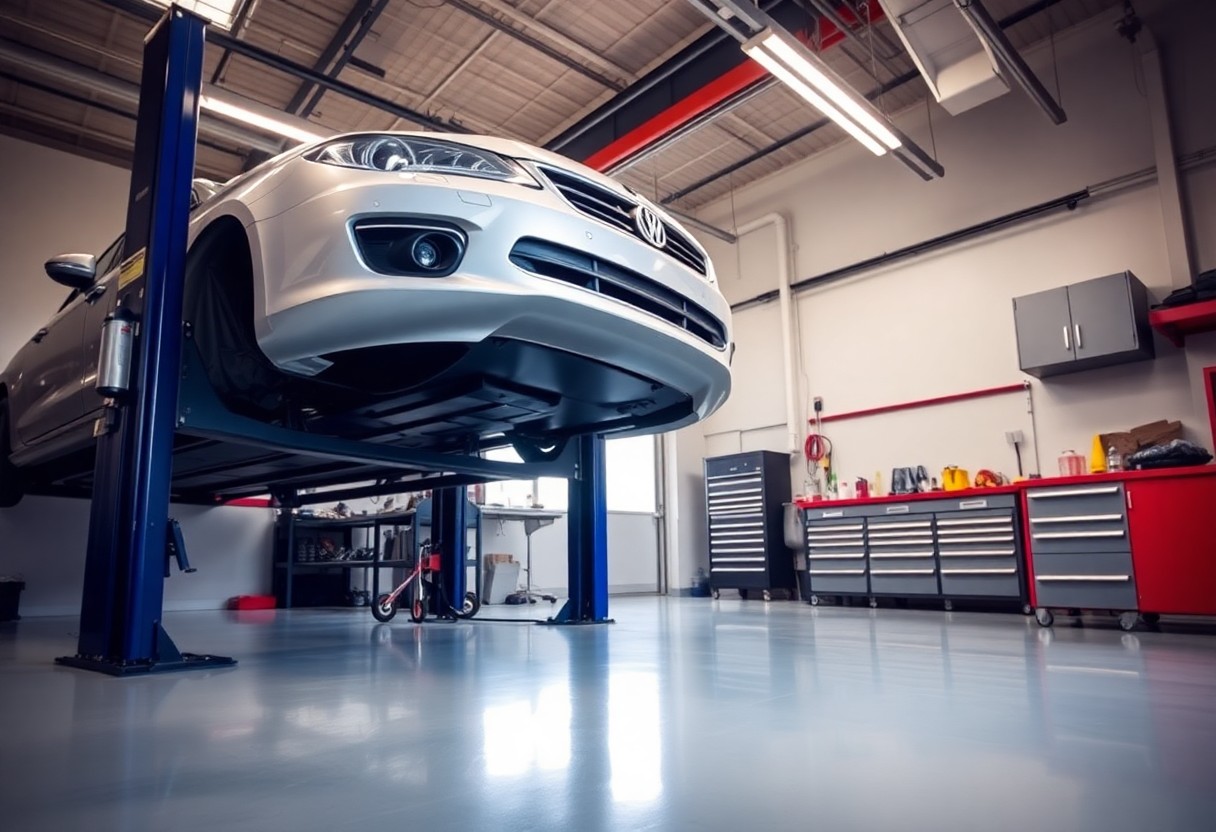
BendPak Suspension
BendPak Suspension

Lifting the chassis off the tires eliminates flat-spotting entirely — the only protocol that works on multi-year storage of performance and exotic vehicles.

How fast does flat-spotting develop in Las Vegas storage?

Timing depends on tire type, ambient temperature, and chassis weight. The table below summarizes the typical onset for vehicles stored in Las Vegas conditions.

Tire Type / VehicleLas Vegas Garage (90–115°F)REVCity Climate (50–70°F)BendPak Lift (0 lbs on tires)
Touring all-season (sedan, SUV)Set in 60–90 days; reversible 30 mi driveSet in 4–6 months; reversibleNone — tires unloaded
Performance summer (sports sedan)Set in 30–60 days; semi-reversibleSet in 90–120 days; reversibleNone — tires unloaded
UHP / N-spec (911, M3, RS6)Set in 21–45 days; often permanentSet in 60–90 days; mostly reversibleNone — tires unloaded
Track / Cup 2 (GT3, Huracan, GT3 RS)Set in 10–30 days; permanent vibrationSet in 45–60 days; semi-permanentNone — tires unloaded
Run-flat (BMW, Mini run-flats)Set in 30–45 days; semi-permanentSet in 90–120 days; semi-reversibleNone — tires unloaded
Vintage bias-ply (classic muscle, pre-1975)Set in 14–30 days; permanentSet in 45–90 days; partly reversibleNone — tires unloaded
PERMANENT VS SEMI-PERMANENT
‘Reversible’ means the flat spot disappears in the first 5–10 miles of driving as the tire heats up. ‘Semi-permanent’ means a vibration remains at highway speed but eases over a few hundred miles. ‘Permanent’ means the vibration never fully clears and the tire requires replacement to restore ride quality. Once you have a permanent flat spot on a Pilot Sport Cup 2 or Trofeo R, the tire is done.

The dollar cost of flat-spotting on real vehicles

Replacement cost varies by vehicle and tire spec. The table below covers common exotic, performance, and luxury vehicles stored at REVCity.

VehicleOE TirePer-Tire Cost (2026)Full Set + Mount/Balance
Porsche 911 GT3 / GT3 RSMichelin Pilot Sport Cup 2 N0$650–$850$3,200–$4,500
Lamborghini Huracan EVOPirelli P Zero Corsa / Trofeo R$900–$1,400$4,500–$6,500
Ferrari 488 / F8 TributoPirelli P Zero F-spec$700–$1,100$3,800–$5,400
McLaren 720SPirelli P Zero Corsa MC1$850–$1,200$4,200–$5,800
Tesla Model S Plaid / Lucid AirMichelin Pilot Sport 4S 21″$550–$700$2,800–$3,600
BMW M5 / Audi RS6 / Mercedes E63Michelin Pilot Sport 4S$400–$650$2,200–$3,200
Rolls-Royce Cullinan / Bentley BentaygaMichelin Latitude Sport 3 / Continental ContiSportContact$550–$850$2,800–$4,000
Classic muscle (Camaro, Mustang, Chevelle)BFGoodrich Radial T/A / Coker Vintage$220–$450$1,200–$2,400
HAGERTY GUIDANCE
Hagerty Insurance recognizes flat-spotting as a documented storage failure on collector and performance vehicles. Agreed-value policies generally cover tire replacement when flat-spotting damage is documented and the storage protocol failure is established. Some Hagerty policies exclude tire damage; verify with broker before storage. Photographs of tire condition at intake matter for any later claim.

The five prevention protocols, ranked

Five protocols exist to prevent flat-spotting on stored vehicles. They are not equivalent — the table below ranks them by effectiveness and ease of use.

1. BendPak 4-post lift (best — zero tire load)
Lifts the chassis fully off the tires. Tires experience zero load. Flat-spotting is impossible. BendPak 4-post lifts are installed at every REVCity space — included in every storage agreement. The only protocol that works on multi-year storage with performance tires.
2. Tire cradles / Race Ramps Flat Stoppers
Curved foam or composite cradles distribute load across a curved surface rather than a flat one. Reduce but do not eliminate flat-spot formation. Roughly $200–$500 per set. Useful when a lift is not available; less effective in Las Vegas heat than climate-controlled environments.
3. Increased inflation pressure (+5 PSI over door spec)
Higher pressure reduces contact patch deformation. Reduces flat-spot formation rate by roughly 30–40%. Free, takes 5 minutes, and is the minimum protocol for any car stored more than 30 days on the ground. Inflate before storage, document the pressure, and verify before driving.
4. Move the vehicle every 30 days
Rolling the vehicle 5–10 feet rotates the contact patch and prevents continuous compression at one point. Effective for daily-driver tires; ineffective for performance and track-spec tires. Logistically impractical for owners not living near their storage facility — REVCity handles this on request as part of vehicle maintenance service.
5. Remove the wheels and store separately
Eliminates tire load entirely. Cost: 2–4 hours of labor and the need for a wheel rack. Risk: paint chipping during removal, fasteners stripped, brake rotor surface rust during long sits. Used by some racing teams; not common in luxury vehicle storage.
Doing nothing — the default failure
Leaving a performance vehicle on the ground at door-spec pressure in Las Vegas heat is the most expensive choice. Onset of permanent flat-spotting in 21–45 days on UHP tires. Replacement cost runs $3,000–$6,500 on most exotics. Hagerty claims data shows tire damage as one of the most common storage-related claims.

BendPak 4-post lifts — the REVCity standard

Every storage space at REVCity includes a BendPak 4-post lift. The 4-post design specifically suspends the chassis on the frame rails rather than lifting from the suspension components. BendPak lifts for car storage covers the full engineering case — the short version is below.

Zero tire load = zero flat-spotting
The chassis sits on the lift rails. Tires hang free. No compression, no contact patch deformation, no belt or cap-ply set. Works indefinitely — 1 year, 5 years, 10 years. The only protocol with zero failure mode on multi-year storage.
Drivetrain unloaded too
Suspension components hang at full droop. Bushings unloaded. CV joint angles relaxed. Spring rates unaffected. Useful on cars with composite leaf springs (Corvette C5/C6/C7) or air suspensions (Range Rover, S-Class, X7) where sustained compression can damage suspension components.
Brake rotor air circulation
Rotors not in contact with ground or pad. Reduces rotor surface corrosion on long sits. Pad-rotor contact rust is a common storage problem on vehicles parked at street level.
Underbody inspection access
BendPak lift positioning provides full underbody visibility. Routine inspection during storage catches developing problems (fluid leaks, suspension wear, mouse intrusion) before they become large problems. See our rodent prevention guide.
Lift height adjustable to vehicle
BendPak 4-post lifts accommodate everything from a 1969 Camaro to a Lamborghini Huracan to a Rolls-Royce Cullinan. Lift height set per vehicle for clearance and accessibility.
Included — not an upcharge
Other Las Vegas storage facilities charge $150–$300 per month for lift access if they offer it at all. REVCity includes a 4-post BendPak at every space — no exception, no upcharge.

Storage prep for tires — the full protocol

Whether the vehicle goes on a BendPak lift at REVCity or stays on the ground in a home garage, run this protocol before storage begins.

1. Inflate to +5 PSI over door spec
Stretches sidewall, reduces contact patch deformation. Inflate cold. Document the pressure on the storage intake form for restart reference.
2. Clean the tires
Wash with non-petroleum tire cleaner. Petroleum solvents accelerate sidewall ozone cracking. Do NOT apply ‘tire shine’ products before long-term storage — most contain petroleum distillates that attack the rubber.
3. Apply a UV-protective dressing
303 Aerospace Protectant, Adam’s Tire Shine, or similar water-based UV blockers. Apply lightly. Re-apply at 6-month intervals if storage is extended.
4. Verify wear and damage at intake
Photograph tread depth and sidewall condition. Catch existing damage before it becomes a storage dispute. Important for Hagerty agreed-value claim purposes.
5. Note manufacture date (DOT code)
Tires age regardless of storage protocol. Manufacturers recommend replacement at 6–10 years from DOT date even on garage queens. Document DOT codes at intake.
6. Choose lift or no-lift at intake
Performance, exotic, classic, and track-prepped vehicles — lift always. Daily-driver SUVs and sedans — lift if available, +5 PSI minimum if not. Climate control doubles the prevention effectiveness regardless of which mechanical protocol is chosen.
Visit REVCity

BendPak 4-post lift at every space — the only Las Vegas storage facility that eliminates flat-spotting entirely

REVCity Auto Storage
7185 Bermuda Rd, Las Vegas NV 89119
Drive Times
  • Henderson12 min
  • Summerlin22 min
  • The Ridges24 min
  • MacDonald Highlands16 min
  • Lake Las Vegas28 min
  • Boulder City30 min
Frequently Asked

Common questions answered directly

What is tire flat-spotting on a stored car?
Flat-spotting is the deformation of the tire contact patch when the tire sits compressed under vehicle weight for extended periods without rotation. The tread compound cold-flows, the steel belts and cap-ply cords take a permanent set, and plasticizers redistribute — locking in a flattened curve at the bottom of the tire. The result is a vibration at highway speed that ranges from temporary (clears in 5–10 miles on touring tires) to permanent (never clears on Pilot Sport Cup 2 or Pirelli Trofeo R track-compound tires).
How long does it take for tires to flat-spot in Las Vegas storage?
Performance and exotic UHP tires (Michelin Pilot Sport Cup 2, Pirelli P Zero Corsa, Toyo R888) develop measurable flat spots in 21–45 days in a Las Vegas garage at 90–115°F. Touring all-seasons take 60–90 days under the same conditions. Climate-controlled storage at 50–70°F extends every interval by roughly 3x. BendPak 4-post lift (chassis suspended, zero tire load) eliminates flat-spotting entirely regardless of storage duration. Call REVCity at 725-272-1803 for storage that includes lift access on every vehicle.
Can flat spots in tires be fixed?
Sometimes. Touring all-season tire flat spots usually self-correct within the first 5–10 miles of driving as the tire heats up and the tread compound relaxes. Performance summer tires sometimes self-correct over several hundred miles. UHP, run-flat, and track-spec tires often do not self-correct — the cap-ply cord set is permanent, and the vibration remains for the rest of the tire’s service life. Replacement is the only fix in that case. Hagerty agreed-value policies sometimes cover tire replacement on documented storage failures; verify with broker.
Does increasing tire pressure prevent flat spots?
Partially. Increasing inflation to +5 PSI over door spec reduces contact patch deformation by roughly 30–40%, which slows flat-spot formation. It does NOT eliminate the problem — tires still sit compressed under chassis weight, just over a smaller contact area. Effective for 30–60 day storage on daily drivers. Inadequate for multi-month storage on performance or exotic vehicles. The only protocol that fully eliminates flat-spotting is a 4-post lift that removes tire load entirely.
Do all REVCity storage spaces include a lift?
Yes. Every storage space at REVCity Auto Storage includes a BendPak 4-post lift. The chassis is suspended on the lift rails, the tires hang free, and flat-spotting is impossible regardless of how long the vehicle is stored. This is included in every storage agreement — there is no per-month lift fee like some other Las Vegas facilities charge ($150–$300/month). Climate-controlled 50–70°F, 40–50% humidity, BendPak at every space, 24/7 gated monitored access. 7185 Bermuda Rd, Las Vegas NV 89119. Call 725-272-1803 to reserve.
DH
Written By
Dustin Hacker
Founder, REVCity Auto Storage & Nostalgia Hot Rods. Two decades restoring, racing, and storing collector vehicles in the Las Vegas Valley. Read full bio →
Reserve Storage With Lift

Las Vegas storage that eliminates tire flat-spotting on every vehicle — BendPak 4-post lift at every space

Climate-controlled 50–70°F (3x slower flat-spot chemistry than garage storage). BendPak 4-post lift at every space (zero tire load — eliminates flat-spotting entirely). 40–50% RH for sidewall preservation. UV-free indoor storage. Call 725-272-1803 to reserve.
Call 725-272-1803 Request Quote
7185 Bermuda Rd, Las Vegas NV 89119