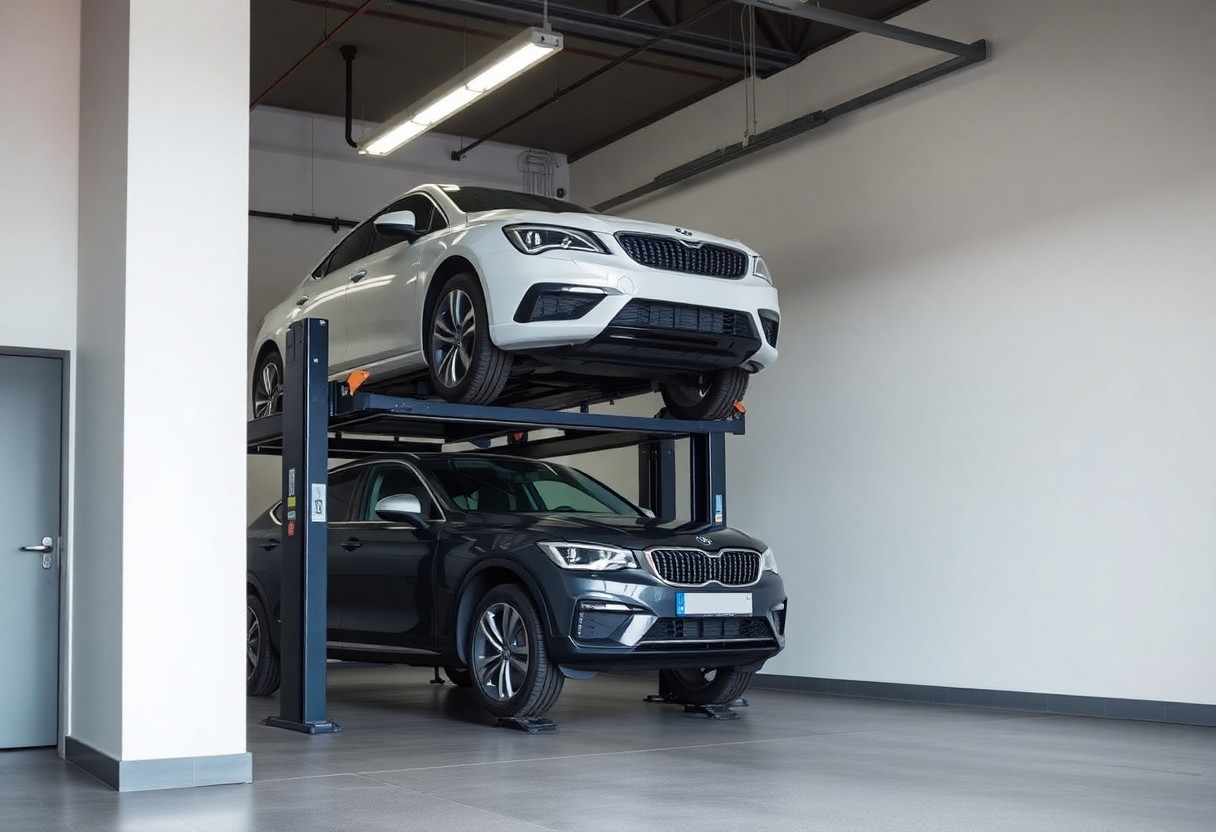
Concierge collection from your building, climate-controlled storage at 50–70°F, and a BendPak four-post lift under every vehicle — ~12 min from Panorama Towers.
Panorama Towers run three buildings along Dean Martin Drive, close enough to the Strip to walk it on a cool evening and directly alongside the I-15 corridor. That location is genuinely convenient. It also puts the buildings in the path of everything a freeway throws into the air. REVCity Auto Storage is ~12 min away at 7185 Bermuda Rd, Las Vegas NV 89119 — call 725-272-1803.
Freeway corridors generate a specific and unglamorous kind of fallout: fine road grime, tyre particulate and brake dust, lifted by passing traffic and carried on the prevailing wind into anything nearby that is open to the air. A multi-level parking structure is, necessarily, open to the air.
Brake dust is the part owners underestimate. It carries iron particles that embed in clearcoat and begin to oxidise in place. It is why an iron-remover chemical decontamination pulls purple streaks off a car that looked perfectly clean after a wash — the contamination was already below the surface and the wash never touched it.
On a vehicle that moves regularly this is a detailing problem solved every few weeks. On a vehicle sitting still for six months, those particles have the entire term to work, and the correction afterwards is machine paint correction rather than a wash and a wax.
Add monsoon-season mineral dust from July through September on top of the freeway contamination, and the picture on a dark car parked in an open structure deteriorates faster than most owners expect.
The sequence matters more than the products, and getting it the wrong way round wastes the effort entirely.
Wash, then chemically decontaminate with an iron remover, then clay the paint, then dry it completely — and only then put the car away. Anything left on the clearcoat when the vehicle goes into storage has months to bond, oxidise and etch, and it does so undisturbed.
This is also the argument for a sealed, filtered building being worth more to an I-15-adjacent resident than to almost anyone else. It does not merely slow the arrival of new contamination; it stops it for the entire term. A car that goes in decontaminated comes out decontaminated, which is not true of any ventilated structure regardless of how new or well kept it is.
Panorama’s scale — three towers sharing structured parking — means the garage carries considerably more resident traffic than a single-building address, particularly at the morning and evening peaks.
For a car in daily use that is a minor irritation. For one that sits, it means more movement around a stationary vehicle over a six-month term, and the contact risk that comes with volume.
Allocation is the other half. Spaces are assigned per residence, and households running a third vehicle find there is nowhere sensible for it to go. What usually follows is the familiar inversion: the collector car takes the assigned space and a daily driver goes outside, which gives the shelter to the vehicle designed for exposure and leaves the one needing preservation with a slightly cooler concrete deck and nothing else.
Wash, iron-remove, clay and dry completely before the vehicle goes away. Contamination sealed onto a panel for six months does not sit there inertly — embedded iron oxidises and alkaline dust etches, and both cost far more to correct afterwards than to remove beforehand.
Owners tend to focus on the 115°F ambient peak, which is the wrong figure to worry about.
Materials do not fail from one hot afternoon. They fail from cumulative exposure, and a concrete parking structure delivers that reliably: it absorbs heat through the day and releases it through the night, so the garage stays warm long after outside air has cooled. Across July and August a parked vehicle experiences sustained elevated temperature for most of every twenty-four hours.
The consequence is that a battery held at 105–110°F for eighteen hours a day across sixty days has aged far more than the calendar suggests — degradation roughly doubles for every 15°F of sustained increase. Tires harden and take a set under static load. Seals shrink. Brake fluid absorbs moisture during monsoon humidity swings and holds it.
None of that is visible on inspection in October. It shows up as a battery that will not crank, a vibration at sixty, or a weep from a seal that was fine in April.
Not every resident needs this, and it is worth saying so.
If you own one car and drive it several times a week, the Panorama structure is doing its job. The freeway contamination is a detailing cycle, the heat is being managed by the fact that the car moves, and there is no case for paying for anything else.
The residents who benefit are the ones whose second or third vehicle has become effectively dormant: driven monthly at best, sitting through the summer, parked in an open structure beside a freeway. For those cars every month is accumulating embedded iron on the paint, a discharging battery, hardening rubber and a flat spot developing under static load.
The other group is part-year residents, whose Las Vegas vehicle sits four to six months and almost always across the summer — the window that does the most damage, and the one nobody is present to notice.
Collection from Panorama Towers is arranged around your building’s loading and valet access, so the vehicle is handled once on the way in and once on the way out. Further reading: our BendPak lift guide, the difference between climate-controlled and temperature-controlled storage, and what Las Vegas heat does to a vehicle.
REVCity sits on Bermuda Road in the airport corridor, ~12 min and roughly ~5 mi from Panorama Towers, and under ten minutes from Harry Reid International.
Approximate drive times from 7185 Bermuda Rd, Las Vegas NV 89119. Actual times vary with traffic and route.
Yes, through contamination rather than heat. Freeway traffic lifts road grime, tyre particulate and brake dust into the air, and open parking structures collect it. Brake dust carries iron particles that embed in clearcoat and oxidise in place, which is what an iron-remover decontamination pulls out as purple streaks.
Wash, chemically decontaminate with an iron remover, clay the paint and dry it completely — in that order and before the vehicle goes away. Contamination sealed onto a panel for a six-month term embeds and etches, and correcting it afterwards is machine paint correction rather than a wash.
The peak is not the issue; the duration is. Concrete structures absorb heat all afternoon and release it all night, so a parked car sits at elevated temperature for most of every twenty-four hours through July and August. Battery degradation roughly doubles for every 15°F of sustained increase, so sixty days at 105–110°F ages a battery far more than the calendar suggests.
Probably not. A vehicle in regular use is managing its own heat cycles, and the freeway contamination is a normal detailing cycle. Storage is for the second or third car that has become effectively dormant, and for part-year residents whose vehicle sits four to six months across the summer.
About twelve minutes, roughly five miles, to 7185 Bermuda Rd, Las Vegas NV 89119 in the airport corridor. Collection is scheduled around the building’s loading access, so the car is handled once on the way in and once on the way out. Call 725-272-1803.
Roughly ~5 mi, about ~12 min outside peak traffic, to 7185 Bermuda Rd, Las Vegas NV 89119 in the airport corridor south of the Strip — and under ten minutes from Harry Reid International.
Yes. Multi-vehicle arrangements are common among high-rise residents precisely because building allocation runs out long before a collection does. Call 725-272-1803 to discuss configuration.
Yes — keep the vehicle insured. What professional storage adds is documented conditions and a condition record, which collector insurers such as Hagerty weigh when settling an agreed-value policy. Confirm the specifics with your own agent.
Founder of REVCity Auto Storage and Nostalgia Hot Rods. Dustin has spent decades building, restoring, and protecting collector and exotic vehicles across the Las Vegas Valley. He built REVCity to be the climate-controlled facility he always wanted for his own cars. Read his story →
50–70°F, 40–50% humidity, zero UV, a BendPak lift under every vehicle and 24/7 monitored access — ~12 min from your building.
REVCity Auto Storage · 7185 Bermuda Rd, Las Vegas NV 89119 · 725-272-1803