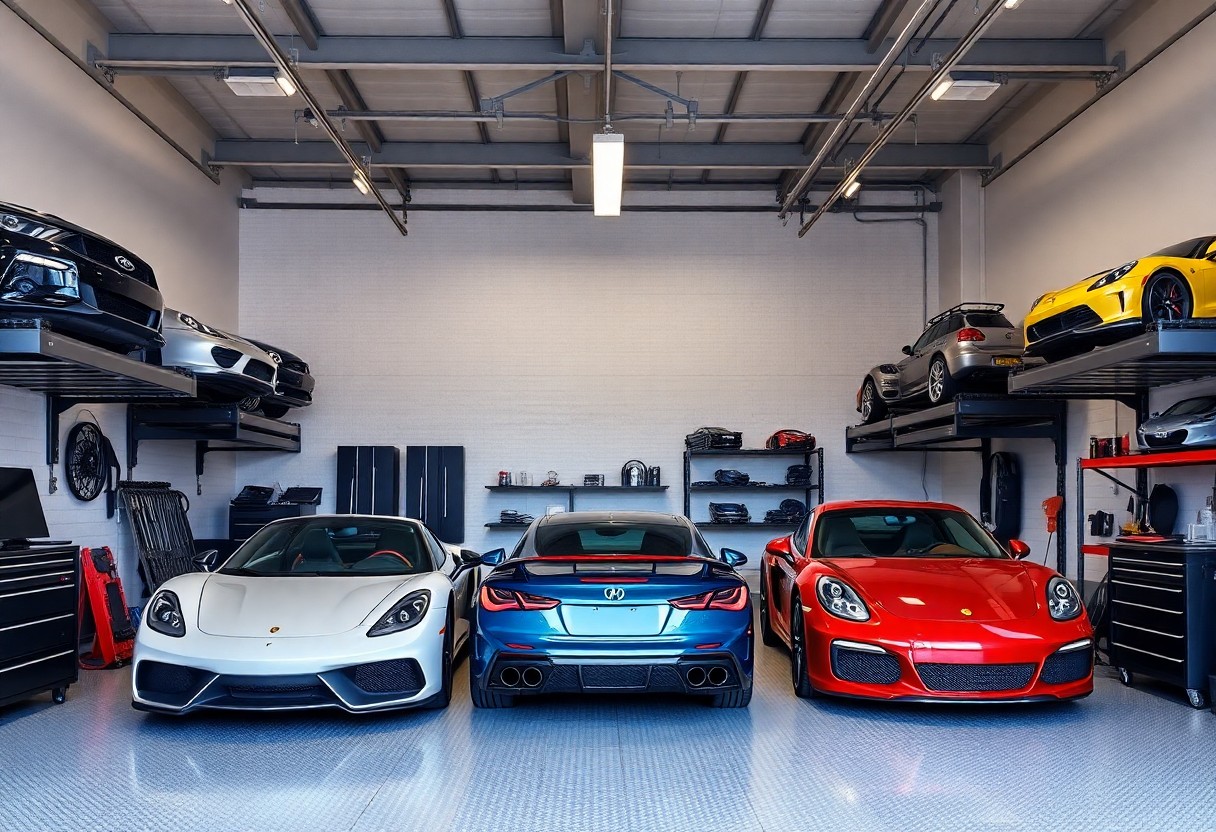
Concierge collection from your building, climate-controlled storage at 50–70°F, and a BendPak four-post lift under every vehicle — ~14 min from Veer.
Veer Towers put you at the dead centre of CityCenter, in two glass towers that lean five degrees in opposite directions, a five-minute walk from Aria and the Shops at Crystals. It is the most genuinely urban address in Las Vegas. It is also the most parking-constrained, and that constraint lands hardest on residents who own a car they do not drive every day. REVCity Auto Storage is ~14 min away at 7185 Bermuda Rd, Las Vegas NV 89119 — call 725-272-1803.
CityCenter was master-planned around pedestrians and porte-cocheres. Vehicle storage was never part of the brief. Resident parking at Veer is a shared structure threaded between Aria, Crystals and the surrounding hotel operations, and it carries that traffic all day and most of the night.
For a daily driver this is a non-issue and arguably an advantage — you are never far from your car and never exposed to the sun walking to it. For a vehicle that sits, three separate factors compound.
The first is thermal. The structure is ringed by glass towers that reflect afternoon sun into and across it, so it runs warmer than an equivalent garage on open ground. The second is traffic: constant guest, valet and delivery movement, which is where door dings, mirror contact and trolley scrapes originate. The third is infrastructure. There is nowhere to run a battery tender to a space you do not own and cannot modify, and no facility anywhere in the structure to lift a vehicle off its tires.
Residents with two vehicles usually find the second becomes a problem inside a year. Residents with three have already solved it somewhere else.
There is also a seasonal dimension that CityCenter residents notice and Summerlin residents do not. The structure’s thermal mass means it lags the outside air by hours in both directions. It is still shedding heat at two in the morning in August, and in December it stays cold well past noon. A vehicle parked there experiences a compressed, delayed version of the outdoor swing rather than an even temperature.
The reason people buy at Veer is that they can leave the car alone for a week and walk everywhere — dinner, the gym, a show, the office if they work on the Strip. That is a genuinely excellent way to live in this city.
It is also, for a vehicle, the worst possible duty cycle. A car driven twice a month in 110°F ambient heat never completes a full heat cycle. The engine reaches operating temperature briefly, if at all, and shuts down before the moisture and unburned fuel that accumulate in the oil are driven off. Meanwhile the battery discharges through the weeks between trips, and it does so faster because it is sitting in a warm structure.
The honest options are two: drive it regularly enough to keep it healthy, or lay it up properly so it is not degrading between drives. The middle ground — occasional short trips out of a hot garage — is the one that quietly costs the most money over five years, and it is exactly the pattern that CityCenter living produces.
There is a practical dimension to CityCenter parking that owners of certain vehicles discover the hard way. The structure was laid out to a standard that assumes standard cars, and a great many vehicles at this address are not standard.
Wide-body cars, anything with dihedral or scissor doors, and vehicles with meaningful front overhang all interact badly with tight bays, sloped transitions and speed tables. A splitter that clears every driveway in Summerlin will find the ramp transition in a dense Strip structure. Owners end up parking across two spaces where they can, which is an imperfect solution socially and no solution at all when the structure is full on a Saturday.
Storage sidesteps this entirely. A vehicle collected once and returned once is exposed to those transitions twice, rather than several times a week, and in between it sits on a flat lift deck in a building sized for exactly this kind of car.
The related issue is tire loading. A car left standing in one position for months develops flat spots, and performance compounds — the Michelin Pilot Sport Cup2s and Pirelli P Zero Corsas that are common at this address — are the most susceptible because their sidewalls are stiff and their compounds are soft. Heat accelerates it. A four-post lift removes the variable entirely by taking the weight off the wheels for the whole term.
Veer residents routinely tell us they drive the collector car once or twice a month. That is worse for the vehicle than either driving it weekly or laying it up properly. Short trips in extreme heat never complete a heat cycle, so moisture and unburned fuel stay in the oil while the battery repeatedly discharges and heat-soaks between outings.
The arithmetic is worth doing explicitly, because the damage from this pattern is invisible month to month and obvious at resale. Sun, heat and monsoon exposure cost a collector vehicle up to 10% of market value across a few Las Vegas seasons — clearcoat degradation, dashboard cracking, seal shrinkage, interior fade.
On a $120,000 car that is $12,000. On something at the level Veer residents tend to own, considerably more. None of it is recoverable through insurance, because progressive environmental wear is maintenance rather than a loss event, and no collector policy — Hagerty, Chubb or otherwise — treats it any differently.
Set against that, the cost of a conditioned space is a rounding error. The decision is not really about storage cost versus garage cost; it is about whether you would rather pay a predictable monthly figure or an unpredictable one at sale.
Not every resident does, and it is worth being straightforward about that. If you own one car and drive it several times a week, the CityCenter structure is fine and this page is not for you.
The residents who benefit fall into three groups. The first is the two-car household where the second vehicle is a weekend car — a 911, a classic, something with a soft top — that gets driven monthly at best. The second is the part-year resident whose Veer residence is one of several homes, where the car sits untouched from May to October. The third is the owner who has simply run out of allocation and is currently paying for a second space, or negotiating with a neighbour, or parking outside.
In all three cases the vehicle is dormant for long stretches in a warm structure with no tender, no lift and no humidity management. That is the specific situation professional storage exists to solve, and it is worth roughly what a second parking space costs.
The fourth group is smaller but growing: owners of electric vehicles who have discovered that a battery held at high state of charge in a warm structure ages measurably faster than one held mid-range in conditioned air. Calendar ageing in a lithium-ion pack is driven by temperature and state of charge, and a CityCenter deck in August is unhelpful on the first count.
Collection from Veer Towers is arranged around your building’s loading and valet access, so the vehicle is handled once on the way in and once on the way out. Further reading: our BendPak lift guide, the difference between climate-controlled and temperature-controlled storage, and what Las Vegas heat does to a vehicle.
REVCity sits on Bermuda Road in the airport corridor, ~14 min and roughly ~6 mi from Veer Towers, and under ten minutes from Harry Reid International.
Approximate drive times from 7185 Bermuda Rd, Las Vegas NV 89119. Actual times vary with traffic and route.
No. Resident parking is a shared CityCenter structure at ambient temperature, and it is partly warmed by sun reflected off the surrounding glass towers. It removes direct UV exposure, which matters, but does nothing about heat itself — and heat is what degrades batteries, tires, seals and interiors across a long term.
It is usually worse. Short infrequent trips in extreme heat never bring the engine to a full heat cycle, so moisture and unburned fuel accumulate in the oil while the battery repeatedly discharges and heat-soaks. Either drive it regularly or lay it up properly; the middle ground causes the most cumulative damage.
It can be. The structure assumes standard vehicle dimensions, so wide bodies, scissor or dihedral doors and low front splitters all interact badly with tight bays, ramp transitions and speed tables. Storing the car means it negotiates those transitions twice — once out, once back — instead of several times a week.
Yes. EVs benefit from conditioned storage more than most vehicles, because lithium-ion calendar ageing is driven by temperature and state of charge. A pack held mid-range at 50–70°F ages far more slowly than the same pack sitting near full charge in a warm structure, and the thermal management system stops fighting the environment continuously. Follow your owner documentation for the recommended storage state of charge.
Not on a four-post lift, which is why every space at REVCity has one. The vehicle’s static weight comes off the wheels for the entire term. Flat-spotting is most pronounced on stiff-sidewall performance compounds such as Michelin Pilot Sport Cup2 or Pirelli P Zero Corsa, and heat accelerates it, so a warm garage is the worst place to leave a car standing on its tires for months.
Roughly ~6 mi, about ~14 min outside peak traffic, to 7185 Bermuda Rd, Las Vegas NV 89119 in the airport corridor south of the Strip — and under ten minutes from Harry Reid International.
Yes. Multi-vehicle arrangements are common among high-rise residents precisely because building allocation runs out long before a collection does. Call 725-272-1803 to discuss configuration.
Yes — keep the vehicle insured. What professional storage adds is documented conditions and a condition record, which collector insurers such as Hagerty weigh when settling an agreed-value policy. Confirm the specifics with your own agent.
Founder of REVCity Auto Storage and Nostalgia Hot Rods. Dustin has spent decades building, restoring, and protecting collector and exotic vehicles across the Las Vegas Valley. He built REVCity to be the climate-controlled facility he always wanted for his own cars. Read his story →
50–70°F, 40–50% humidity, zero UV, a BendPak lift under every vehicle and 24/7 monitored access — ~14 min from your building.
REVCity Auto Storage · 7185 Bermuda Rd, Las Vegas NV 89119 · 725-272-1803