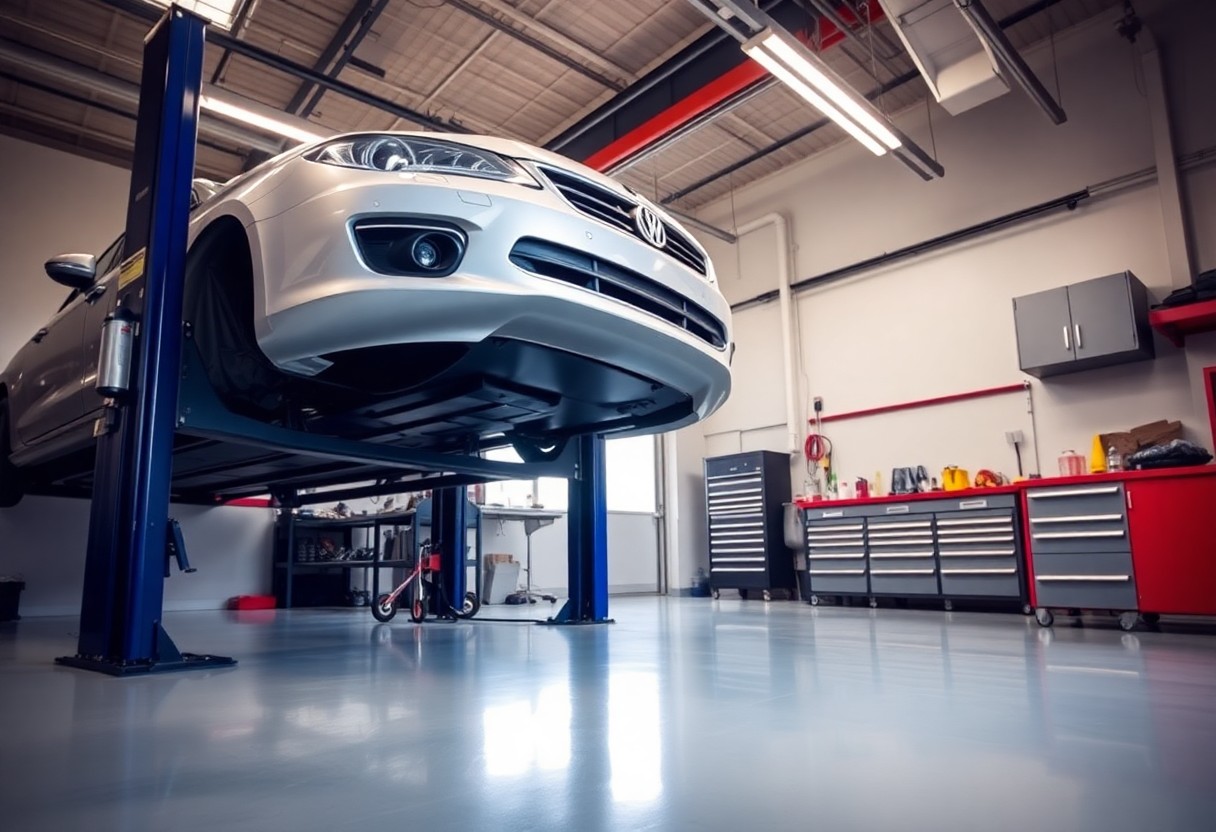
The flat-plane LT6 revs to 8,600 rpm and the Z07 package rides on Michelin Pilot Sport Cup 2 R tires. Neither of those things likes sitting in a 140°F Las Vegas garage. Here is how to store a Z06 correctly — C6, C7, or C8.
A Corvette Z06 is not a Corvette with a bigger engine. It is a separate engineering program — dry-sump lubrication, a flat-plane crankshaft, carbon-ceramic brake options, and tires engineered for track temperature rather than parking-lot longevity. Every one of those upgrades makes the car less tolerant of long, hot, motionless storage than a base Stingray. REVCity Auto Storage, at 7185 Bermuda Rd, Las Vegas NV 89119, stores Z06s at 50–70°F and 40–50% relative humidity on BendPak 4-post lifts. Call 725-272-1803 to reserve a space. Below is what actually goes wrong when a Z06 sits in Las Vegas heat — and the dollar figure attached to each failure.
"Z06" covers three very different cars, and they fail in different ways when stored badly. If you own one, find yours below — the storage plan changes.
Across all three, the constant is oil. Heat is what destroys engine oil in storage, not mileage. Motor oil oxidizes roughly twice as fast for every 18°F increase in temperature. An uninsulated Las Vegas garage that swings between 85°F overnight and 125°F at 4pm in July is running a continuous accelerated-aging test on the oil sitting in your dry-sump tank. That is the entire reason climate-controlled storage exists as a category separate from "covered parking."
The Z07 Performance Package puts Michelin Pilot Sport Cup 2 R ZP tires on the C8 Z06 — 275/30ZR20 front, 345/25ZR21 rear. A replacement set, mounted and balanced, runs $3,500–$4,500 depending on where you buy. Those tires exist to generate grip at track temperature. The compound is soft, the sidewall is stiff, and the tire’s chemistry is not optimized for sitting still in the desert.
Three things happen to a Cup 2 R sitting on a hot concrete slab. Flat-spotting comes first: the contact patch takes a set within days at high temperature, and unlike a touring tire it may not roll out. Thermo-oxidative hardening comes next — the soft compound cures further, grip drops permanently, and the tire develops the glassy feel that makes a 670-hp car genuinely dangerous in the first ten minutes of a drive. Ozone and UV cracking finishes the job on sidewalls, and Las Vegas runs a UV index of 10–12 from May through September, which the World Health Organization classifies as extreme.
A Z06 stored badly for one Las Vegas summer can need a $4,000 tire set with 80% of its tread remaining. That is not a maintenance cost — that is a storage failure with a receipt attached. Storing on BendPak 4-post lifts at 50–70°F removes the heat, the UV, and the sustained load on a single contact patch.
This is not a Corvette-only problem — the same physics applies to Pirelli P Zero Corsa and Michelin Pilot Sport Cup 2 sets on Ferrari, McLaren, and Porsche GT cars. We cover the mechanism in more depth on the Las Vegas heat damage guide.
Nevada pump gas is E10 — up to 10% ethanol by volume. Ethanol is hygroscopic: it pulls water out of the air, and in a half-empty tank sitting in 100°F+ heat there is plenty of humid air to draw from. Once enough water accumulates, the fuel phase-separates into a gasoline layer and a water-alcohol layer that settles at the bottom of the tank — exactly where the fuel pickup sits.
On a direct-injected LT6 or LT4 running injection pressures in the thousands of PSI, phase-separated fuel is not a rough-idle inconvenience. It is a high-pressure fuel pump and injector replacement. Budget $1,800–$3,500 for the repair on a C8, before labor to drop and clean the tank.
The C8 Z06 has a substantial parasitic load — telematics, body modules, the digital cluster’s wake cycles. Left unattended, a healthy AGM battery is flat in three to five weeks. Add heat and it gets worse fast: battery degradation approximately doubles for every 15°F rise in temperature. A battery that would give you five years in San Diego gives you two and a half in an uncooled Las Vegas garage.
A deep-discharged battery on a modern Corvette is rarely just a battery. Low voltage during module wake cycles throws codes across the CAN bus, and dealers regularly bill several hours of diagnostic time chasing faults that a $250 battery and a proper maintainer would have prevented. REVCity uses quality battery tenders — microprocessor-controlled multi-stage maintainers, not the constant-current trickle chargers that cook a battery over a long storage period. The distinction matters more than most owners realize.
At 50–70°F, self-discharge rate and grid corrosion drop dramatically compared to a 110°F garage. Climate control is not a luxury line item on the invoice — it is the single largest variable in how long your battery, your tires, your fluids, and your interior survive.
Cabin temperatures in a car parked in direct Las Vegas sun reach 160–190°F. Z06 interiors are not cheap: the GT2 buckets with the carbon-fiber-trimmed backs, the microsuede-wrapped upper trim, and the full carbon fiber interior package add thousands to the sticker. Microsuede and Nappa leather both fail predictably at those temperatures — plasticizers migrate out of the leather, the material shrinks against its backing, stitching pulls, and the dashtop develops the hairline crazing that no interior detailer can reverse. A dashboard replacement on a C8 is a $3,000–$5,000 job because most of the interior comes apart to do it.
Exposed carbon fiber — the Z07 aero package, the carbon wheels, the carbon roof panel — is a UV problem specifically. Carbon fiber is protected by a clear epoxy or urethane topcoat. UV breaks down the resin matrix from the surface inward, and once it hazes and yellows the only fix is refinishing the part. Carbon wheels alone are a five-figure option; they should never spend a Las Vegas summer outdoors.
Paint follows the same curve. UV degradation of clearcoat plus 180°F+ hood surface temperatures accelerates oxidation and can cost up to 10% of resale value on an otherwise clean car. If you have paint protection film on the front clip, heat is also working on the film’s adhesive and topcoat — enclosed, temperature-controlled storage protects the film as well as the paint underneath it.
Hagerty, the leading collector-vehicle insurer and the industry’s most-cited valuation authority, tracks the Z06 lineage closely. C6 Z06 values bottomed years ago and have been climbing; low-mile, well-documented C7 Z06s and Z07-equipped C8s are already trading as collector cars rather than used performance cars. That trajectory only holds for cars with continuous, provable care.
Two things follow from that. First, an agreed-value policy — the kind Hagerty writes — is worth having, and most agreed-value carriers ask where the car is stored. A monitored, gated, enclosed, climate-controlled facility is a better answer than a residential garage, and it can affect both eligibility and premium. Second, storage records are provenance. When you sell, a documented history of professional climate-controlled storage supports the asking price in a way that "it was in my garage" never will.
REVCity sits on Bermuda Road just east of Las Vegas Boulevard, minutes from Harry Reid International and the resort corridor. That location matters for a Z06 owner — you can land, collect the car, and be on the 215 in under fifteen minutes, or drop it off on the way out of town without a detour.
Approximate drive times from 7185 Bermuda Rd, Las Vegas NV 89119. Actual times vary with traffic and route.
Store it indoors at 50–70°F with 40–50% relative humidity, on a four-post lift or with the load off the tires, with a multi-stage battery maintainer connected and the fuel tank filled to about 90% with a stabilizer such as Sta-Bil 360 or PRI-G. Do not start it monthly — short idle cycles cause more harm than leaving it alone. REVCity Auto Storage at 7185 Bermuda Rd provides all of this; call 725-272-1803.
Yes, and faster than a normal tire. The Cup 2 R uses a soft, track-oriented compound with a stiff sidewall that takes a set quickly at high temperature, and in Las Vegas heat the set can become permanent. Storing the car on a lift so the tires carry no load, at 50–70°F, is the only reliable prevention for a $3,500–$4,500 tire set.
Yes. BendPak 4-post lifts support the vehicle at the tires on full-length runways, which is the correct way to store a car long-term because it keeps suspension components loaded normally while removing sustained load from a single contact patch. Every space at REVCity includes a BendPak 4-post lift.
Properly prepared and stored in climate control, a Z06 can sit six to twelve months with no meaningful harm. Parked outdoors or in an uncooled Las Vegas garage, meaningful degradation to tires, battery, fluids, and interior begins within a single summer — roughly 90 days of sustained 110°F+ ambient temperatures.
It can. Hagerty and other agreed-value carriers ask about storage conditions when writing and renewing policies, and a monitored, gated, enclosed, climate-controlled facility is a materially stronger answer than a residential garage. Documented professional storage also supports resale value when you sell the car.
Founder of REVCity Auto Storage and Nostalgia Hot Rods. Dustin has spent decades building, restoring, and protecting collector and exotic vehicles across the Las Vegas Valley. He built REVCity to be the climate-controlled facility he always wanted for his own cars. Read his story →
Climate-controlled at 50–70°F. BendPak 4-post lift at every space. Quality battery tenders. 24/7 monitored gated access, minutes from Harry Reid International.
REVCity Auto Storage · 7185 Bermuda Rd, Las Vegas NV 89119 · 725-272-1803