The short answer is yes — and in a 118°F Las Vegas garage the wrong cover does more paint and interior damage than no cover at all. Here is the physics, the dollar cost, and what actually protects a collector car in Southern Nevada.
A car cover is a moisture and abrasion barrier. It is not a thermal barrier. In an uninsulated Las Vegas garage that hits 118°F by 4 p.m. in July, a non-breathable cover holds hot, humid air against clearcoat for 14 hours a night and turns your $180 investment into a paint-blistering incubator. At REVCity Auto Storage, 7185 Bermuda Rd, Las Vegas NV 89119, we store vehicles at a constant 50–70°F and 40–50% relative humidity, which is the only condition where a cover does exactly what it was designed to do and nothing else. Call 725-272-1803 to talk through your specific car.
Heat moves three ways: conduction, convection, radiation. A fitted car cover blocks exactly one of them well — radiation. It stops direct solar and reflected infrared from hitting the panel. That is genuinely useful outdoors at noon. What it does badly is convection. Under the cover you create a dead-air envelope roughly 3 to 12 millimeters thick that cannot exchange with the room. Once the panel and the surrounding garage air are both hot, that envelope has no way to shed heat.
In practice this means a covered car in a hot garage cools down more slowly than an uncovered one. Sheet metal that reached 140°F at 5 p.m. is still sitting at 105°F at midnight, while the uncovered car next to it has dropped to 92°F. Over a 90-day Las Vegas summer that is roughly 700 extra hours of elevated panel temperature — which is precisely the variable that drives clearcoat cross-linking failure, adhesive creep in badges and trim, and plasticizer migration out of dashboards and door cards.
The damage is not the peak temperature. It is the dwell time at elevated temperature combined with trapped moisture. A cover shortens neither. In a garage that swings from 118°F down to 88°F overnight, the air under the cover crosses its dew point against cool sheet metal and deposits condensation directly onto paint — every single night, for months.
That nightly condensation cycle is the mechanism behind the two most expensive failure modes we see on cars that arrive at REVCity from home garages: clearcoat delamination on horizontal surfaces (hood, roof, decklid) and chrome pitting on bumpers and window surrounds. Neither is cheap. A single-panel clearcoat correction and respray on a Porsche 911 runs $1,400 to $2,600 at a Las Vegas shop that does color-matched blends properly. A full hood, roof, and decklid respray on a classic with original single-stage paint destroys the originality premium entirely — on a numbers-matching car that can be a $15,000 to $40,000 hit at auction.
Cover marketing splits roughly into two camps. Non-breathable covers use a solid polyethylene or PVC-backed laminate. They are waterproof, cheap, and completely wrong for indoor Las Vegas use. Breathable covers use a spunbond polypropylene or a multi-layer nonwoven that passes water vapor at a measurable rate — usually expressed in grams per square meter per 24 hours.
Notice what the table makes obvious. Every cover, at every price point, addresses surface contact and light. Not one of them addresses air temperature or relative humidity. A $1,100 satin-lined Ferrari cover in a 118°F garage is a very expensive way to keep dust off a car that is still cooking. Hagerty, the leading collector car insurance authority, has been consistent on this point for years: environment control comes first, surface protection second. A cover is the last five percent of a storage plan, not the first ninety.
Southern Nevada monsoon season runs July through September, and the fine alkaline silt it deposits is abrasive. Pulling a cover on or off a dusty car is functionally wet-sanding it with 3000-grit. Every cover removal on an uncleaned surface adds micro-marring. Over a three-year storage period that is a full paint correction — $1,800 to $3,500 on a large-panel exotic — caused entirely by the thing that was supposed to protect the paint.
Quantifying heat damage is not guesswork. The failure curves for automotive materials are well characterized, and Las Vegas sits at the far end of nearly all of them. Here is what accumulates in a covered car in an uncooled garage over a single Nevada summer.
Run the arithmetic honestly. The cover cost $400. The summer cost somewhere between $3,000 and $34,000 depending on the car. That is the entire argument for controlling the air instead of wrapping the car, and it is why every serious collection in the Las Vegas Valley ends up in a facility rather than a residential garage. For the full breakdown of what Southern Nevada heat does to a parked vehicle, see our guide to Las Vegas heat damage.
This is not an argument that covers are useless. It is an argument that they solve a narrow problem and get sold as if they solve a broad one. Used correctly, in the right environment, a good cover earns its money.
Never cover a car that is not clean and completely dry, and never cover a car in an uncooled Las Vegas garage between May and October. If those two conditions cannot be met, the cover is doing net harm and you are better off leaving the car uncovered.
If you are weighing whether a residential garage can be made good enough, the honest answer is that it can — with a mini-split, a dehumidifier, and insulation, at roughly $9,000 to $18,000 installed plus $120 to $260 a month in Nevada Energy summer load. That is a real option for some owners. It is not cheaper than professional storage, and it does not come with 24/7 monitored gated access or a BendPak 4-post lift at every space.
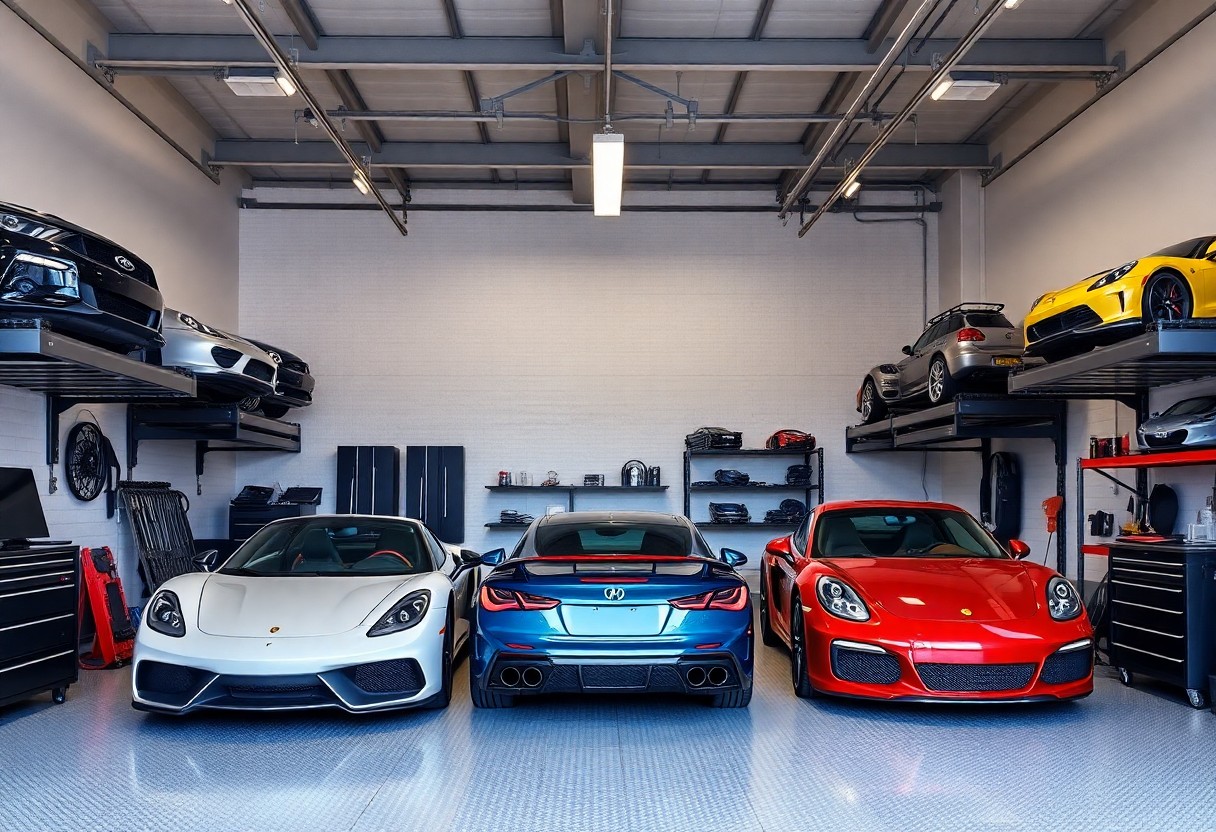
REVCity Auto Storage is the only purpose-built climate-controlled luxury vehicle storage facility in Las Vegas. The building is fully enclosed, so UV exposure is zero — not reduced, zero. Air is held at 50–70°F with relative humidity managed to 40–50%, the range at which leather, rubber, and steel are all simultaneously stable. Climate control at those parameters reduces corrosion risk by up to 90% and extends interior lifespan by up to 50%.
Owners who want a cover on top of that are welcome to use one, and inside our environment it is a sensible finishing touch. The difference is that at REVCity the cover is protecting against dust and nothing else, because everything else has already been handled. Compare the terminology carefully — many Las Vegas facilities advertise temperature control, which is not the same thing. Our breakdown of climate-controlled versus temperature-controlled storage explains why humidity management is the part that matters. For how the lift system works, see BendPak lifts and car storage in Las Vegas.
REVCity sits just east of the Las Vegas Strip on Bermuda Road, minutes from Harry Reid International and inside a 30-minute drive of every major residential community in the valley. Drop-off before a trip and pickup on return are straightforward from anywhere in the metro.
Approximate drive times from 7185 Bermuda Rd, Las Vegas NV 89119. Actual times vary with traffic and route.
Yes. A car cover creates a thin dead-air envelope against the paint that cannot exchange heat with the surrounding room, so a covered car cools down measurably slower than an uncovered one. In a Las Vegas garage reaching 118°F, that means several hundred extra hours per summer at elevated panel temperature, which accelerates clearcoat failure and interior plasticizer loss.
In an uncooled Las Vegas garage between May and October, yes — an uncovered car sheds heat faster overnight and avoids nightly condensation against the paint. The only exception is a genuinely breathable multi-layer cover on a car that is spotlessly clean and completely dry. The real fix is controlling the air temperature and humidity, not the cover choice.
For indoor use, a multi-layer breathable cover such as Covercraft WeatherShield HP or Noah, at $280 to $600. Never use a non-breathable PVC or polyethylene tarp indoors — it traps moisture against the clearcoat and causes blistering. No cover at any price controls temperature or humidity, which is why climate-controlled storage outperforms every cover.
Yes, in two ways. Pulling a cover on or off a dusty car drags abrasive monsoon silt across the clearcoat and causes micro-marring that accumulates into a full paint correction — $1,800 to $3,500 on a large exotic. Non-breathable covers also trap condensation against the surface, which leads to clearcoat delamination and chrome pitting.
No, though you are welcome to use one. REVCity holds vehicles at 50 to 70°F and 40 to 50% relative humidity inside a fully enclosed, zero-UV building with 24/7 monitored gated access. Inside that environment a cover only manages incidental dust. Call 725-272-1803 to discuss your vehicle.
Founder of REVCity Auto Storage and Nostalgia Hot Rods. Dustin has spent decades building, restoring, and protecting collector and exotic vehicles across the Las Vegas Valley. He built REVCity to be the climate-controlled facility he always wanted for his own cars. Read his story →
REVCity Auto Storage — 50–70°F, 40–50% humidity, zero UV, BendPak lifts at every space, 24/7 monitored access in Las Vegas.
REVCity Auto Storage · 7185 Bermuda Rd, Las Vegas NV 89119 · 725-272-1803