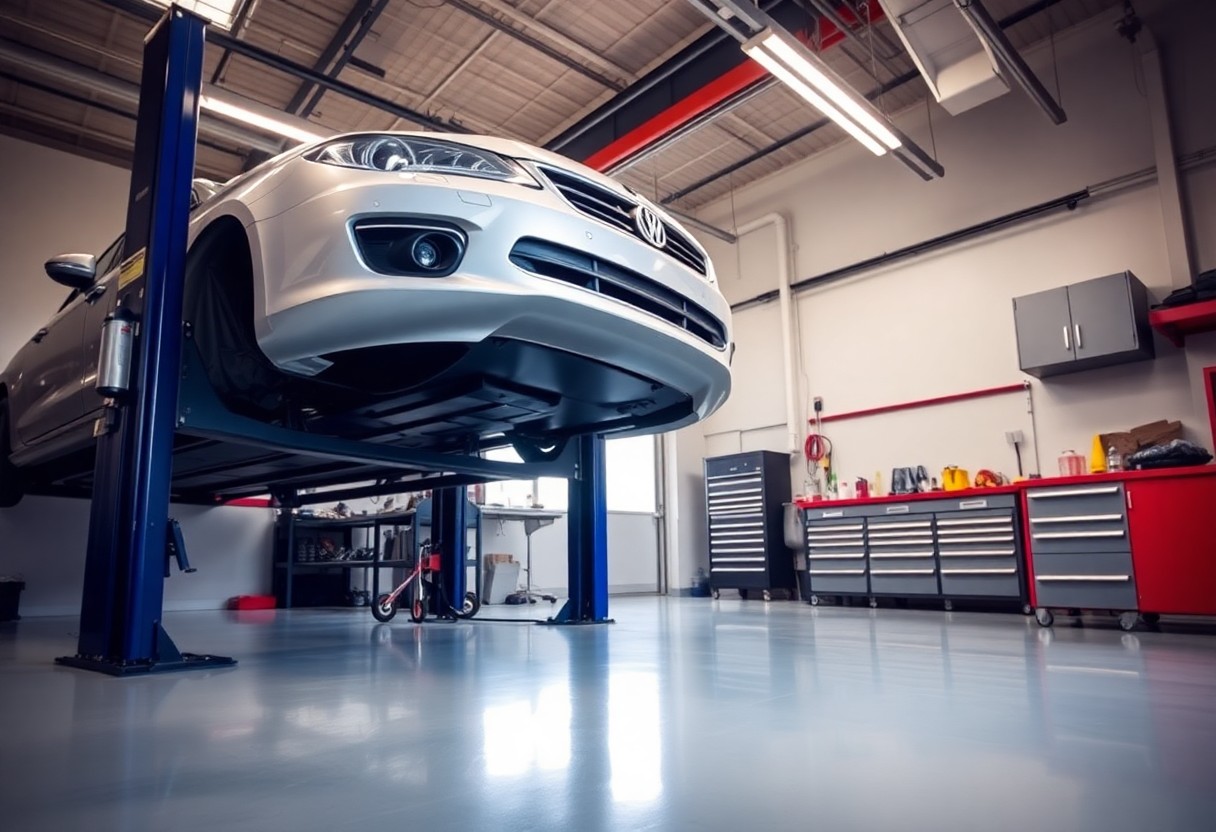
Concierge collection from your building, climate-controlled storage at 50–70°F, and a BendPak four-post lift under every vehicle — ~25 min from One Queensridge Place.
One Queensridge Place sits on the west side near Summerlin, two European-styled towers set back from the city in a way no Strip-adjacent building can match. Its residents are the furthest from the resort corridor of any high-rise in this group, and statistically the most likely to own a genuine collection rather than a car or two. REVCity Auto Storage is ~25 min away at 7185 Bermuda Rd, Las Vegas NV 89119 — call 725-272-1803.
By high-rise standards the parking here is generous, and for most residences it is more than sufficient. Collections are a different category of problem entirely.
Once a household is running five, eight or a dozen vehicles, no residential allocation in any building is going to hold them, and at that point the question changes shape. It stops being where to park and becomes how to preserve.
That shift matters because the two questions have different answers. Parking asks for a space and a door. Preservation asks for conditioned air, unloaded suspension, maintained batteries per chemistry, stabilised fuel and a documented condition record — which is what insurers actually look at.
West-valley geography adds a factor of its own. Queensridge sits closer to open desert than the Strip corridor does, so monsoon-season dust from July through September arrives with less between it and the buildings, and parking structures are ventilated by design.
For a collection, the environment is table stakes and the record-keeping is the differentiator.
Hagerty, the leading collector-vehicle insurer, weighs documented storage conditions and maintenance history when settling agreed-value policies. A professionally logged storage history is evidence. A private garage produces recollection, and the difference between those two things does not matter at all until it matters completely — at a claim, or at sale when a buyer’s inspector asks where the car has been.
The practical requirements follow from that: consistent and specified conditions, per-vehicle documentation, suspension unloaded for the term, correct battery maintenance matched to chemistry, and an arrangement that scales as the collection does rather than being capped at whatever came with the residence.
Collections are rarely homogeneous, and the mix creates requirements a single-car owner never encounters.
A pre-war or early classic wants stable humidity above all, because it has more untreated metal, more natural materials and older seals than anything modern. A carbon-bodied modern exotic wants temperature stability, because epoxy resin softens as it approaches its glass transition point and thermal cycling drives print-through and delamination. An electric vehicle wants a moderate state of charge and cool air, because lithium-ion calendar ageing is driven by temperature and state of charge together.
A conditioned building at 50–70°F and 40–50% relative humidity satisfies all three simultaneously, which a garage cannot do for any of them. That is the practical reason mixed collections end up in one facility rather than being distributed across several compromises.
For a collection, storage documentation is not administrative overhead — it is the evidence that determines whether an agreed-value claim settles at the number you expect or becomes a negotiation. Photographed, logged, professionally maintained storage produces that record. A private garage does not.
Residents with collections reasonably worry that the logistics will be worse than the problem. In practice it is the opposite, because the movement is scheduled rather than improvised.
Vehicles are collected from Queensridge on an agreed timetable rather than driven across the valley individually, which for a household in the west valley is roughly a twenty-five minute run each way per car. Each is photographed and logged at intake, so the record starts immediately and independently.
Rotation is then a scheduling conversation. The car for this season comes out; the others stay laid up. Nothing needs to be moved on a Saturday, and nobody needs to shuttle a second driver across town to bring the transport car back.
The obvious alternative for a Queensridge household is to build or buy garage space, and some do. It is worth being fair about where that does and does not make sense.
A purpose-built private garage with climate control, lifts and monitoring is an excellent solution and a substantial capital project. It requires the land, the plant, the electrical capacity for lifts and tenders, and ongoing maintenance of the conditioning equipment — and the conditioning is the expensive part, because holding 50–70°F and 40–50% humidity through a Las Vegas August is a real mechanical load.
Professional storage delivers the same specification as an operating expense rather than a capital one, with the lifts, the tender infrastructure, the monitoring and the documentation already in place, and with the ability to scale up or down as the collection changes.
For a household certain of its collection size and willing to fund the build, private is defensible. For most, paying for the specification rather than the building is the better arithmetic — particularly since the specification is what preserves the cars, not the ownership of the roof.
Collection from One Queensridge Place is arranged around your building’s loading and valet access, so the vehicle is handled once on the way in and once on the way out. Further reading: our BendPak lift guide, the difference between climate-controlled and temperature-controlled storage, and what Las Vegas heat does to a vehicle.
REVCity sits on Bermuda Road in the airport corridor, ~25 min and roughly ~15 mi from One Queensridge Place, and under ten minutes from Harry Reid International.
Approximate drive times from 7185 Bermuda Rd, Las Vegas NV 89119. Actual times vary with traffic and route.
It is generous for a high-rise and still finite. Once a household runs five or more vehicles, no residential allocation holds them, and the question shifts from parking to preservation — conditioned air, unloaded suspension, correct battery maintenance and a documented condition record.
Vehicles are photographed and logged at intake, and conditions are consistent and specified at 50–70°F and 40–50% relative humidity. That record matters because collector insurers such as Hagerty weigh documented storage and maintenance history when settling agreed-value policies. Confirm your own requirements with your agent.
Yes, and one conditioned environment suits all three. Classics need stable humidity for older seals and untreated metal; carbon-bodied moderns need temperature stability because epoxy resin softens near its glass transition point; EVs need cool air and a moderate state of charge because lithium-ion calendar ageing is driven by temperature and charge level together.
It is a defensible option if you are certain of your collection size and willing to fund it. It needs land, plant, electrical capacity for lifts and tenders, and ongoing maintenance — and the conditioning is the expensive part, because holding 50–70°F through a Las Vegas August is a real mechanical load. Professional storage delivers the same specification as an operating expense that scales.
On an agreed timetable rather than car by car. Queensridge is roughly twenty-five minutes from the facility, so moving several vehicles individually is a significant undertaking; scheduled collection removes it. Each vehicle is photographed and logged at intake. Call 725-272-1803 to arrange.
Roughly ~15 mi, about ~25 min outside peak traffic, to 7185 Bermuda Rd, Las Vegas NV 89119 in the airport corridor south of the Strip — and under ten minutes from Harry Reid International.
Yes. Multi-vehicle arrangements are common among high-rise residents precisely because building allocation runs out long before a collection does. Call 725-272-1803 to discuss configuration.
Yes — keep the vehicle insured. What professional storage adds is documented conditions and a condition record, which collector insurers such as Hagerty weigh when settling an agreed-value policy. Confirm the specifics with your own agent.
Founder of REVCity Auto Storage and Nostalgia Hot Rods. Dustin has spent decades building, restoring, and protecting collector and exotic vehicles across the Las Vegas Valley. He built REVCity to be the climate-controlled facility he always wanted for his own cars. Read his story →
50–70°F, 40–50% humidity, zero UV, a BendPak lift under every vehicle and 24/7 monitored access — ~25 min from your building.
REVCity Auto Storage · 7185 Bermuda Rd, Las Vegas NV 89119 · 725-272-1803