
What Humidity Level a Stored Car Actually Needs
Every guide gives you a percentage. Almost none says where the number came from, and not one of them is written for a desert. In Las Vegas the risk sits at the other end of the scale entirely.
Ask what humidity a stored car wants and you get a number. Ask where the number came from and the answer usually stops. REVCity Auto Storage is at 7185 Bermuda Rd, Las Vegas, NV 89119, holding 50 to 70°F and 40 to 50% relative humidity all year. Call 725-272-1803 about space. Here is what that range is for, and why the bottom of it matters more in this valley than the top.
The Published Ranges Disagree With Each Other
Read four guides on storage humidity and you will get four answers. That’s worth knowing before you trust any single one of them.
Cotes, a dehumidifier manufacturer, states that “relative humidity should be maintained at between 35% and 55%”, and in a case story on the same page describes a collector who chose not to exceed 45%. Read in full on 13 October 2026, that page cites no source for either figure. Other guidance in the same search describes 50% as the balance point. So the published range sits somewhere between 35% and 55%, depending on who is writing and what they sell.
None of that’s dishonest. It’s just unsourced, and the spread is wide enough to matter. A building at 35% and a building at 55% aren’t doing the same thing to a car.
We hold 40 to 50%. We’re not going to tell you that’s the one correct answer, because the published guidance does not support that claim. What we can do is explain what each end of the scale does, so the number stops being a number and starts being a reason.
Every Guide Is Written for the Wrong Climate
Here’s the part that should change how you read all of it. Search this subject and the results are written by people solving a wet problem.
One of the top guides is about storing classic cars in Florida. Another is a dehumidifier maker in Denmark. A third is a dehumidification company selling to museums. Every one of them assumes the air around your car holds too much moisture, and every recommendation follows from that assumption: take water out.
The Mojave doesn’t have that problem. Air in this valley runs dry, and it runs dry for most of the year rather than for a season. A building here that only removes moisture is solving a problem the desert already solved, and ignoring the one it created. That’s why dry air damages leather, rubber and wood in a stored car is a real page on this site and not a curiosity.
So when a guide tells you to dehumidify, check where it was written. Advice built for Tampa isn’t advice for Las Vegas, and right now almost all of the advice is built for Tampa.
What Each End of the Scale Does to a Car
A range has two limits because there are two different failures, and they don’t look alike.
| End of the scale | What it attacks | What you see |
|---|---|---|
| Too damp. | Bare and coated steel, electrical contacts, upholstery. | Surface corrosion, a musty cabin, mould on leather and carpet. |
| Too dry. | Leather, rubber, adhesives, timber trim. | Cracked hide, perished seals, lifting veneer, brittle hoses. |
| In range. | Nothing in particular. | A car that comes out the way it went in. |
The damp end is the one every guide covers, and it’s genuinely serious. Corrosion needs moisture, and a car parked in damp air for months will find it.
The dry end gets almost no coverage, which is the gap this page exists to fill. Leather is a hide. Rubber seals and hoses rely on plasticisers that migrate out faster in dry air. Timber veneer and the adhesive under it move with moisture content. None of that announces itself the way rust does. You notice it when you sit in the car and the seat bolster’s gone hard, or when a door seal has taken a permanent set.
Cotes, writing for a damp climate, describes what high humidity does and does not say what happens below its own 35% floor. For a reader in the desert, the floor’s the only half of that advice that applies.
Temperature and Humidity Are Two Different Controls
This is where most garage conversations go wrong, and it isn’t a small distinction.
Cooling air changes its temperature. It also changes how much water that air can hold, which is why a cold garage and a controlled garage aren’t the same room. A unit that only watches a thermostat can hold a steady temperature while the moisture content drifts wherever the outside air takes it. Holding a humidity range is a separate job that needs separate measurement, and climate control against temperature control is the whole of that difference.
It is also why what temperature to store a car at is only half the question. A number on a thermostat tells you nothing about the air around the hide and the seals.
A home garage here follows the outside. It gets hot in July, cold in January, and the moisture content does whatever the weather does. That’s tolerable for a daily driver. It’s a slow tax on a car that’s going to sit.
What We Hold, and What We Will Not Claim
Plainly: 50 to 70°F and 40 to 50% relative humidity, held year round, in a building with no daylight in it.
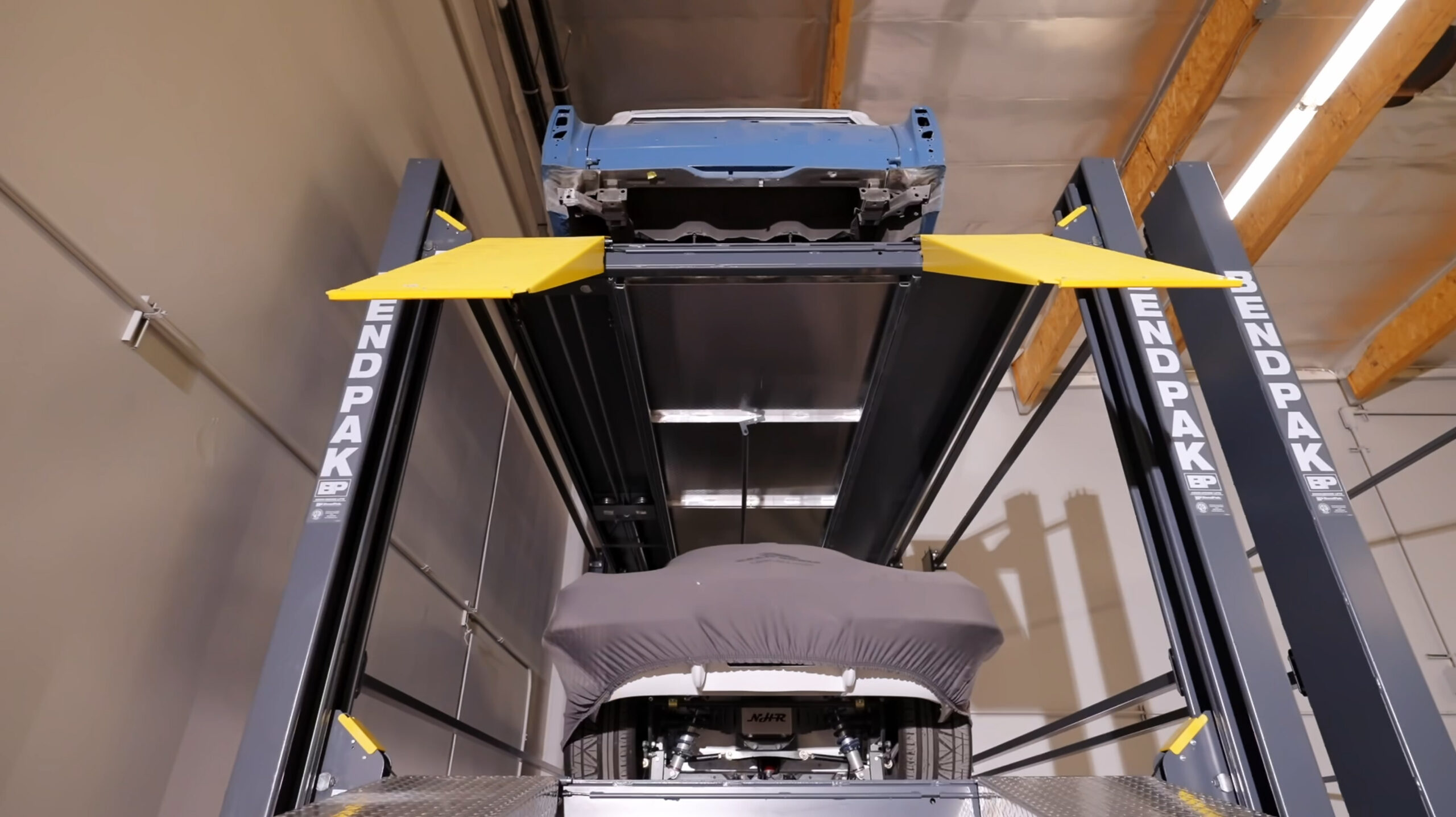
That range sits inside the published guidance rather than at either edge of it, and it keeps a floor under the air for exactly the reason above. Every space carries a BendPak four post lift, so tyres are not standing on one patch of concrete for months, and batteries sit on quality tenders rather than trickle chargers. Access is gated and monitored around the clock.
| What we state | What we will not state |
|---|---|
| 50 to 70°F, held year round. | The make or model of the equipment. |
| 40 to 50% relative humidity. | The humidistat setting or a tolerance. |
| A BendPak four post lift at every space. | A corrosion rate for your vehicle. |
| No daylight in the building. | A figure we have not measured. |
What we won’t do is publish a specification we haven’t measured for you. We aren’t naming the equipment, the humidistat setting or a tolerance figure, and we’re not quoting you a corrosion rate. If you want to know how the building is controlled in more detail than this, ask when you walk through it, because that’s a question that deserves a real answer rather than a brochure line.
How long a car stays barely changes the setup. A season, a winter or an open ended arrangement all run the same protocol, described in long term car storage in Las Vegas.
Insurance, Liability and Who Carries What
Climate is one risk. It isn’t the only one, and the paperwork side catches people out.
A storage building’s own insurance covers the building and the building’s negligence. It isn’t cover on your vehicle, and a careful owner keeps their own policy in force rather than assuming otherwise. What suits a car being driven often isn’t what suits one standing still for five months, and how insurance works on a stored vehicle covers that properly.
There is a Nevada wrinkle worth knowing before you change anything: the order of operations between your registration and your policy is fixed by the state, and getting it backwards costs money. registration and insurance while your car sits in storage sets out what the DMV actually requires.
We’re a storage building, not an insurer or the DMV, and we won’t advise you on either. What we’ll say is both questions are worth settling before the car goes in rather than after.
How Storing a Car With Us Actually Starts
The process is short, and there’s no reason to make it sound clever.
Most owners book a walkthrough first, because the building is the thing that answers the questions on this page better than any paragraph can. You see the lifts, you see the spaces, and you can put your hand on the air. From there we schedule a drop off that suits you and go through the intake with the car in front of us.
Bring the car clean if you can. A wash and a dry before it comes in is worth more than anything you can do to it afterwards, because settled grit is abrasive and a cover over a dirty car makes that worse rather than better.
What a month costs depends on the vehicle and the space it needs, so ask rather than work from a number you saw somewhere else. We will tell you what is available.
If you’re splitting the year between here and somewhere cooler, the Las Vegas snowbird guide covers that rhythm, and how to prepare a car for long term storage is the checklist to work through before the drop off.
Owners store with us from Summerlin, Henderson, The Ridges, MacDonald Highlands, Seven Hills, Southern Highlands, Lake Las Vegas and Boulder City.
Frequently Asked
Published guidance puts it somewhere between 35% and 55% relative humidity, and the sources disagree. Cotes states 35% to 55% and cites nothing for it. Other guidance calls 50% the balance point. REVCity holds 40 to 50%, which sits inside that guidance rather than at either edge. Treat any single number you’re given as a starting point and ask where it came from.
They damage different things. Damp air attacks steel, contacts and upholstery and shows up as corrosion and mould. Dry air attacks leather, rubber, adhesives and timber and shows up as cracking and perished seals. In the Mojave the dry end is the one you’re far more likely to meet, which is the opposite of what most storage guidance assumes.
That depends entirely on the climate it sits in. Guidance written for Florida or northern Europe means dehumidification, because the ambient air holds too much water. In a desert the job runs the other way for most of the year, and a building that only removes moisture is solving a problem the desert already solved.
No, and that’s the point. Cooling air changes what it can hold, so a steady thermostat reading tells you nothing about the moisture around the seals and the hide. Holding a humidity range is a separate job with separate measurement.
We aren’t publishing the make, model or humidistat setting, because we’d rather state what we hold than market a specification. What we’ll state is the result: 50 to 70°F and 40 to 50% relative humidity, year round. Ask on a walkthrough and you can see the building for yourself.
No. Air is one of several risks. Tyres take a set if a car stands on them for months, which is why every space here carries a four post lift, and a battery left alone will flatten, which is why they sit on quality tenders. Insurance is a separate question again. Call 725-272-1803 and ask about availability.
Come and Stand in the Building
Climate controlled storage for exotic, classic and collector vehicles, held at 50 to 70°F and 40 to 50% relative humidity with BendPak lifts at every space, quality battery tenders and 24 hour monitored gated access. 7185 Bermuda Rd, Las Vegas, NV 89119.
7185 Bermuda Rd, Las Vegas, NV 89119