A stuck clutch disc is the most common and most avoidable failure in manual-car storage. Almost everyone causes it the same way, in the last ten seconds before they walk away.
Manual cars are over-represented among the vehicles worth storing. The gated-shifter Ferraris, the air-cooled 911s, the four-speed muscle cars, the enthusiast-spec E46 and S2000 and Miata that people actually keep — three pedals is a strong signal that a car is being preserved rather than used up. It also introduces one failure mode an automatic simply does not have. REVCity Auto Storage keeps three-pedal cars at 7185 Bermuda Rd, Las Vegas NV 89119, and this is the protocol we run. Questions on your specific car: 725-272-1803.
Here is what happens mechanically. The clutch disc is a friction plate clamped between the flywheel face and the pressure plate. Both mating surfaces are bare cast iron or steel — unpainted, uncoated, and by design slightly porous. The disc itself is an organic or ceramic friction material that holds moisture readily.
Park the car with the clutch pedal depressed and blocked, or with the disc otherwise held in contact under spring pressure, and you have clamped a moisture-retaining friction material against bare iron for months. Surface oxidation forms at the interface. The rust bonds the disc to the flywheel. When you eventually start the car and let the clutch out, nothing disengages — the disc turns with the flywheel whether the pedal is down or not, and the car lurches or the engine stalls in gear.
This is the single piece of storage advice that has aged worst. It circulated for decades on the theory that it relieves the pressure plate springs. It does not meaningfully help the springs, and it guarantees the disc stays clamped against the flywheel for the entire storage period. A wooden block on the clutch pedal is the most reliable way to seize a clutch.
The second-order damage is worse than the bond itself. Freeing a lightly stuck disc sometimes works — start in gear on a lift or with the drive wheels chocked, then work the clutch under load until it breaks free. Freeing a badly stuck one usually means pulling the transmission. On a modern sports car that is $1,400 to $4,200 in parts and labour. On a mid-engine exotic with a transaxle it is considerably more, and on a gated-shifter Ferrari you are into five figures before anyone touches the clutch itself.
This is the actual decision, and the honest answer is that it depends on where the car is stored — which is why the internet argues about it endlessly without resolving anything. Both camps are right about different facilities.
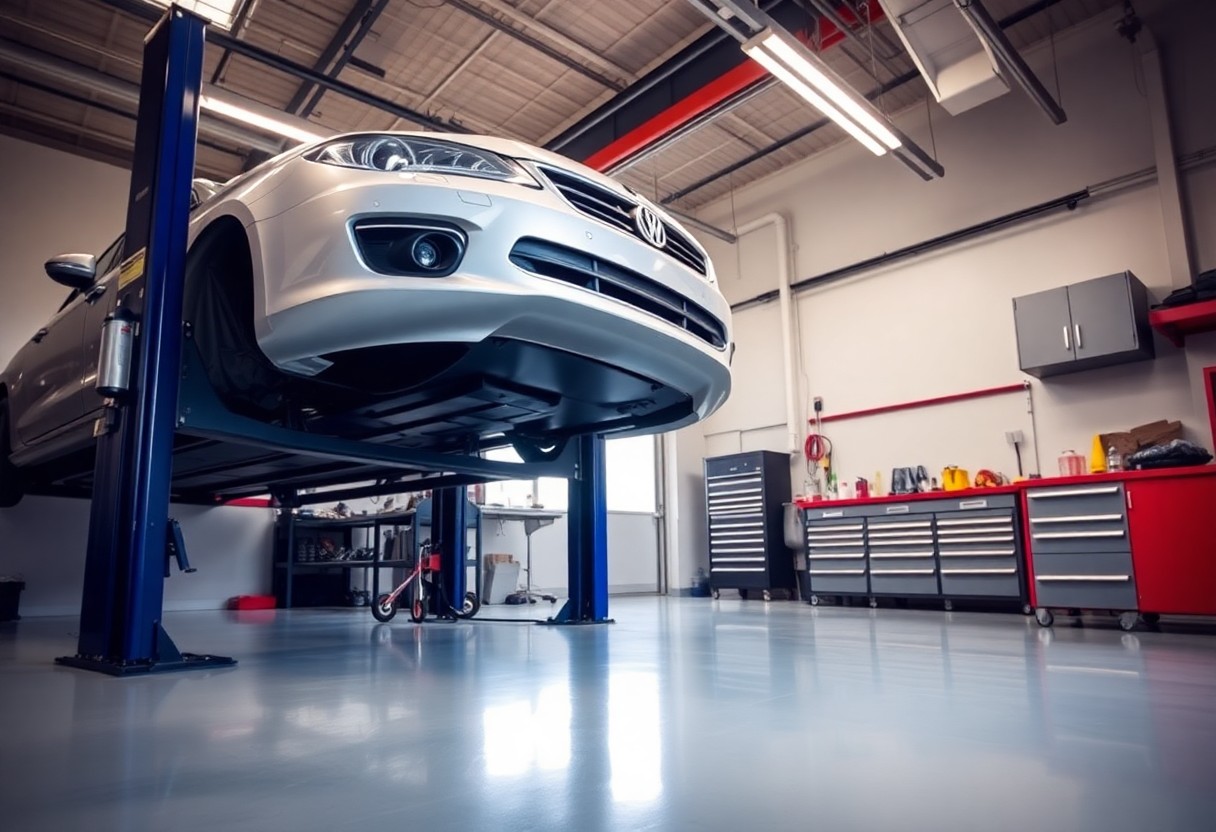
Our default for cars on the floor at REVCity is neutral with chocks, because the floor is level, the space is dedicated and the building is monitored around the clock. For a car stored on a BendPak four-post lift the question mostly evaporates — the wheels are cradled on the runways, the car is not going anywhere, and neutral is unambiguously correct. Here is how the lift system works.
What is not up for debate: the clutch pedal comes up, and the parking brake stays off. Whichever gear you settle on, those two are constant.
Partly, and it is worth being precise about it rather than assuming desert air solves the problem. Clutch-disc seizure is a moisture-driven oxidation process, and Las Vegas averages 310-plus sunny days with baseline relative humidity in the teens. A manual car stored in a dry Las Vegas building genuinely is at lower risk of a stuck clutch than the same car in a Seattle garage. That much is true.
Then July arrives. Monsoon season runs July through September and drives sharp humidity spikes into a valley that has been arid for months. The problem is not the humidity in isolation — it is the swing. Metal that has been temperature-cycling in an uncooled building is frequently below the dew point of the incoming humid air, and condensation forms directly on the flywheel face, the rotors and the brake lines. Three or four of those cycles is all a clutch interface needs.
A building that holds temperature but not humidity still lets moisture in during monsoon season. Holding 50–70°F and 40–50 percent relative humidity together is what keeps the flywheel face above the condensation threshold year-round. The difference between the two is not marketing — it is the whole mechanism.
Heat does its own separate damage while the humidity is doing that. Interior temperatures in a closed, unconditioned Las Vegas building reach 160–190°F, and every rubber and elastomer component in the clutch hydraulic circuit ages on an accelerated curve at those temperatures. Master cylinder seals, slave cylinder boots and the flexible section of the clutch line all degrade faster. The broader heat-damage picture is here, and the humidity distinction is in climate controlled versus temperature controlled storage.
Two systems on a manual car get overlooked because owners run the same storage checklist they would use on an automatic.
Beyond that, a manual car takes the same core preparation as anything else: treated fuel on a near-full tank, a fresh warm oil change, tires up or the load taken off entirely, and a microprocessor battery maintainer rather than a trickle charger. On the battery specifically, the distinction matters more than people expect — here is why. On tires, soft compounds flat-spot inside 30 days at normal pressure: the flat-spotting mechanism.
Recommissioning a manual car has one extra step, and it goes before you drive anywhere.
The one thing not to do during the storage period is start the car every few weeks and let it idle to "keep things moving." It does not free a clutch, it does not exercise the gearbox, and a ten-minute idle never reaches the oil temperature needed to boil condensation out of the crankcase — so each start adds water and fuel dilution and shuts down before removing either. Hagerty has advised against periodic start-ups for years and the reasoning holds. The full argument is here.
Pre-1980 manual cars add a wrinkle: many use non-synchronised first gear and unlined organic clutch discs that bond faster than modern friction material. On those, storing in neutral in a humidity-controlled building is not a preference — it is the only sensible option. See storing a classic car long term and classic muscle car storage in Las Vegas.
REVCity is on Bermuda Road just east of Harry Reid International, on a level, sealed, climate-held floor — which is exactly the condition that makes neutral-and-chocked the correct storage selection for a manual car.
Approximate drive times from 7185 Bermuda Rd, Las Vegas NV 89119. Actual times vary with traffic and route.
In a level, secured, monitored indoor facility, store it in neutral with wheel chocks. Neutral leaves no standing load on the gears, synchros or shift linkage. Leave it in gear only if the floor is sloped, the space is unsecured, or you cannot inspect the car regularly. Never engage the parking brake in either case.
No. This is outdated advice and it causes the exact failure it claims to prevent. Holding the pedal down clamps the clutch disc against the flywheel for the whole storage period, and surface oxidation bonds the two together. Leave the clutch pedal fully up and released.
The clutch disc is a moisture-retaining friction material pressed against a bare cast-iron flywheel face. Moisture at that interface causes surface oxidation that bonds the disc to the flywheel, so the clutch no longer disengages when the pedal is pressed. Humidity swings — like Las Vegas monsoon season from July through September — are the main driver.
With the drive wheels off the ground or on lift runways, start the engine with the clutch pedal pressed and the car in gear, then apply light throttle to break the bond. Never attempt this with the car on the ground and unrestrained. If it does not release, the transmission has to come out — typically $1,400 to $4,200 on a modern sports car.
If the gear oil is near its service interval, change it before the car sits. Old fluid carries acids and suspended metal that rest against synchro cones for the entire storage period. Use the specified grade — GL-5 where GL-4 is called for will attack the yellow-metal synchros. Flush the clutch hydraulic fluid too if it is over two years old.
Lower baseline humidity does reduce clutch-seizure risk compared with a damp climate, but it does not eliminate it. Las Vegas monsoon season drives sharp humidity spikes onto metal that has been temperature-cycling, and condensation forms directly on the flywheel face. Holding 40–50 percent relative humidity year-round, not just controlling temperature, is what removes the risk.
Founder of REVCity Auto Storage and Nostalgia Hot Rods. Dustin has spent decades building, restoring, and protecting collector and exotic vehicles across the Las Vegas Valley. He built REVCity to be the climate-controlled facility he always wanted for his own cars. Read his story →
Level climate-controlled floor, BendPak four-post lifts, 50–70°F and 40–50% humidity year-round. Call and we will set your car up right.
REVCity Auto Storage · 7185 Bermuda Rd, Las Vegas NV 89119 · 725-272-1803