Valley dust is not dirt. It is angular silica and gypsum driven at 40–60 mph into every panel gap, brake duct and intake on your car. Here is exactly what it costs you — and what a sealed building prevents.
Every July the Valley trades dry heat for something worse for a parked car: wind-driven mineral dust followed by humidity. A car sitting in a home garage or an outdoor lot from July through September takes a season of abrasive loading that shows up later as swirl marks, clogged cabin filters, seized brake hardware and corrosion in places you cannot see. REVCity Auto Storage at 7185 Bermuda Rd, Las Vegas NV 89119 keeps collector and exotic vehicles inside a sealed, filtered, climate-controlled envelope at 50–70°F and 40–50% relative humidity year-round. Call 725-272-1803 to talk through monsoon-season space.
The dust that moves through the Valley during monsoon season is not organic soil. It is pulverized desert crust — quartz silica, gypsum, caliche carbonate and fine clay lifted off the dry lakebeds and disturbed construction pads that ring the metro. Quartz sits between 7 and 9 on the Mohs hardness scale. Automotive clearcoat sits around 2 to 4. That single comparison is the whole problem.
When a gust front rolls in ahead of a monsoon cell, it carries that material at 40 to 60 mph. Particles do not settle gently onto a car. They arrive with kinetic energy, embed in the clearcoat, and lodge in every shut line, cowl vent, brake duct and wheel-well seam. The car does not look damaged afterward. It looks dirty. The damage happens on the next wash.
Embedded silica plus a wash mitt equals wet sanding. Every pass drags angular mineral across the clearcoat under hand pressure. This is why a car that only ever gets washed carefully still develops a haze of fine scratches after a Las Vegas summer — the abrasive was already sitting in the paint before the mitt touched it.
On a solid dark finish the result is visible as swirl marks under direct sun or LED light. On a metallic or a candy multi-stage finish it reads as a dulling of flake pop. Neither is repaired by polish alone once the clearcoat is thinned; on a limited-production car, the correction bill is real money.
These are Las Vegas market ranges for the work that follows a hard monsoon season on an uncovered or loosely covered vehicle. Detail shops in the Valley quote seasonally, and exotic finishes carry a premium because of paint depth and panel complexity.
Hagerty, the leading collector car insurance authority, underwrites agreed-value policies on the assumption that condition is maintained. Cosmetic degradation from environmental exposure is not a claimable event — it is depreciation. A car that loses its finish over three Las Vegas summers loses that value permanently, and UV and heat exposure compound it. That interaction is covered in depth on the Las Vegas heat damage guide.
Owners tend to think of dust as a paint problem. The expensive failures are internal, because fine particulate follows airflow paths that stay open whether the car is running or not.
Las Vegas averages 310-plus sunny days and spends most of the year at single-digit to low-teens relative humidity. Monsoon season breaks that pattern. Moisture surges into the Valley ahead of storm cells, and relative humidity can climb from roughly 10% to well past 50% inside a few hours — then fall back once the cell passes.
That swing is what turns dust from a cosmetic issue into a corrosion issue. Dry dust sitting on bare metal is inert. Dust plus moisture forms an electrolyte layer that holds water against the surface long after the air has dried out. Hygroscopic components in Valley dust — particularly the salts and gypsum fraction — pull moisture out of humid air and keep it there.
A closed home garage slows dust ingress. It does not control humidity, and it does not stop the daily temperature swing that drives condensation onto cool metal surfaces — brake rotors, bare suspension hardware, exhaust internals, fuel tank surfaces. Sealing dust out without controlling moisture simply traps a humid, dusty environment around the car.
Stable humidity is the control that matters, and it is the distinction between genuinely conditioned storage and a building that merely runs air conditioning. That difference is broken down on the climate-controlled vs temperature-controlled storage page. REVCity holds 40–50% relative humidity year-round — low enough to shut down corrosion chemistry, high enough that leather, rubber seals and wood veneer do not dry and crack.
The car-cover row surprises people. A cover on an outdoor car in a Valley windstorm does not shield the paint — it becomes a grit-loaded fabric moving against the finish under wind pressure. It is a mechanical polishing pad with mineral abrasive on the contact face.
REVCity was purpose-built for this climate rather than converted from general warehouse space. The building envelope is sealed — not a roll-up door on a metal shell — and conditioned air is filtered before it reaches the storage floor. There is no direct sunlight on any stored vehicle, so the UV load that runs 10 to 12 on the index from May through September never touches paint, dash tops or seals.
A single multi-stage correction on an exotic runs $2,800 to $4,800 and consumes clearcoat you cannot get back. Storing the car through monsoon season instead is a fraction of that, and it is the only option on the list that also handles UV, heat, humidity, tyre flat-spotting and battery health at the same time.
REVCity sits at 7185 Bermuda Rd, just east of the resort corridor and minutes from Harry Reid International. That location matters during monsoon season — the drive in is short, so the car spends minimal time exposed on the way to a sealed building.
Approximate drive times from 7185 Bermuda Rd, Las Vegas NV 89119. Actual times vary with traffic and route.
Monsoon season runs July through September, with the heaviest activity typically in late July and August. The risk to a stored car is not only rain — it is the dust-laden gust front that arrives ahead of each storm cell at 40 to 60 mph, followed by a sharp humidity spike.
Not on an outdoor vehicle. Wind drives dust through and under the cover, and the loaded fabric then moves against the paint under gust pressure. That is an abrasive pad on the clearcoat. Covers are useful indoors, in still air, over already-clean paint — not as outdoor storm protection.
Washing is necessary but it is also when most of the scratching happens, because embedded silica gets dragged across the clearcoat by the mitt. If a car has taken a dust storm, it needs a thorough contact-free pre-rinse and chemical decontamination before anything touches the paint. Avoiding the exposure is cheaper than managing it.
It reduces dust but controls nothing else. Unconditioned garages track outdoor humidity and temperature, so the monsoon moisture surge still reaches the car and condenses on cool metal. Dust that does get in through door seals then sits in that moisture. You need sealed plus conditioned, not one or the other.
In the Las Vegas market, multi-stage paint correction runs roughly $1,500 to $2,600 on a sedan and $2,800 to $4,800 on an exotic, before any radiator cleaning, filter replacement or brake hardware service. Clearcoat is a finite resource — each correction removes some permanently.
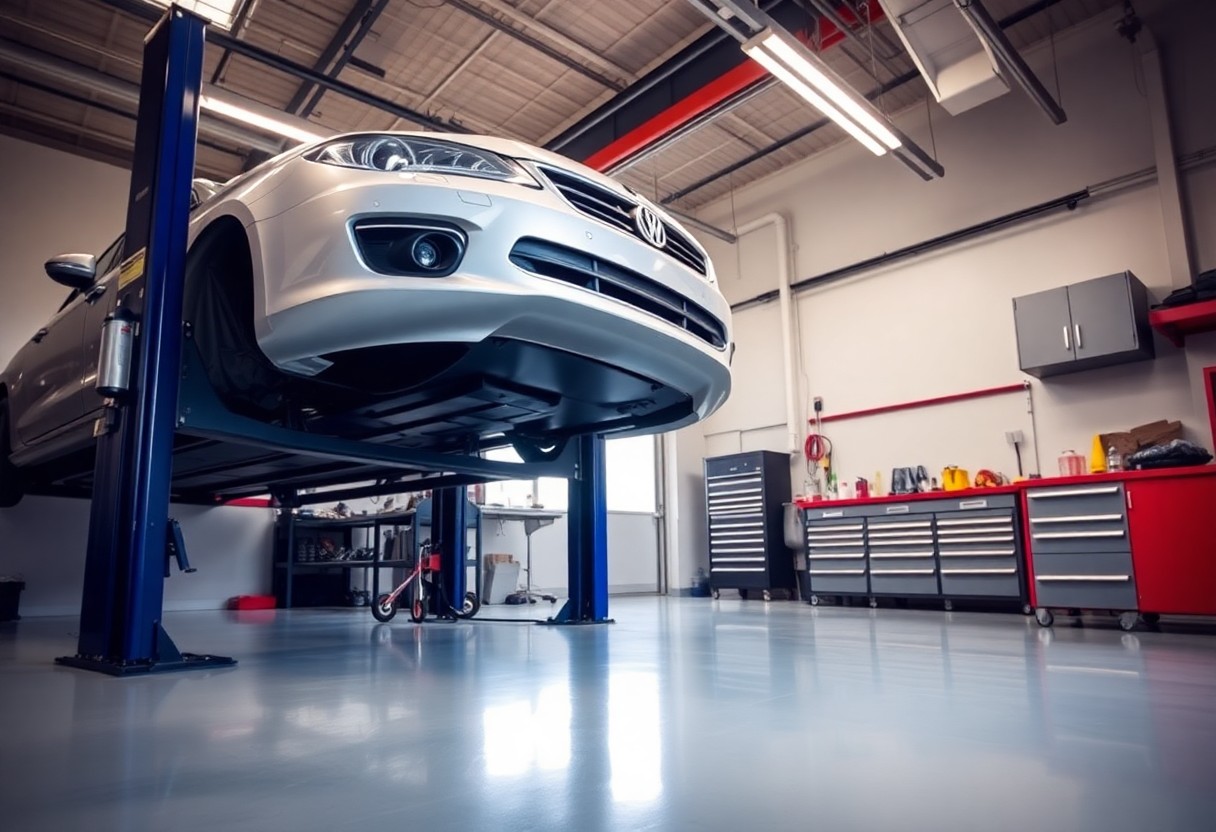
50 to 70°F and 40 to 50% relative humidity, year-round, inside a sealed and filtered building with no direct sunlight on any vehicle. Every space includes a BendPak four-post lift and a quality battery tender. Call 725-272-1803 for current availability.
Founder of REVCity Auto Storage and Nostalgia Hot Rods. Dustin has spent decades building, restoring, and protecting collector and exotic vehicles across the Las Vegas Valley. He built REVCity to be the climate-controlled facility he always wanted for his own cars. Read his story →
Sealed, filtered, climate-controlled storage minutes from the Strip. 7185 Bermuda Rd, Las Vegas NV 89119. Spaces are limited through monsoon season.
REVCity Auto Storage · 7185 Bermuda Rd, Las Vegas NV 89119 · 725-272-1803