The fabric is rarely what fails first. It’s the thread holding it together and the adhesive holding the rear window in, and both of those take their worst punishment from a car that is parked rather than driven.
A convertible top is not one material. It’s a fabric or vinyl outer, a lining, a set of seams stitched with thread, an adhesive bond around the rear window, and a frame with joints and often hydraulics. Sun and heat work on every one of those at a different rate, and the ones that fail first are usually the ones you cannot see. That process runs fastest when the car is standing still in the sun for months. REVCity Auto Storage at 7185 Bermuda Rd, Las Vegas NV 89119 stores convertibles in a fully enclosed building at 50 to 70°F and 40 to 50% relative humidity. Call 725-272-1803 about space.
Owners judge a top by how the outer material looks, because that is the part on show. Fading and chalking are real and they’re what makes a car look tired. But a faded top is still a working roof. The failures that actually take a car off the road start somewhere else.
Ultraviolet light breaks down polymers, and thread is a polymer with a very small cross section. A seam has far less material in it than the panels it joins. So the same exposure that merely fades a panel can take real strength out of the stitching. That is why a top can look serviceable and then open a seam without warning. The same applies to the adhesive bonding a glass rear window into the fabric. It is a thin layer, it is often darker than the material around it, and it is doing a structural job.
Vinyl and cloth age differently and want different care. Vinyl contains plasticisers that keep it flexible, and sustained heat drives them off, which is what leaves an old vinyl top stiff, shrunken and prone to cracking at the folds. Cloth tends to fade and lose its coating before it loses its structure. Neither one enjoys this climate, and a product suited to one is not automatically right for the other.
A parked car in this valley does not sit at one temperature. It climbs hard from mid morning, peaks in the afternoon, then drops away overnight, every day, for months. Fabric, glass, adhesive and the metal frame underneath all expand and contract at different rates through that swing. The bond between glass and fabric is where those differences meet, and it is the joint that gets worked hardest. This is the mechanism behind a rear window that separates at one corner without anything obvious having happened to it.
A convertible that gets used is a convertible that gets looked after by accident. The top goes up and down, so the fabric flexes instead of setting in one position. The car moves between sun and shade. Somebody notices a seam starting to fray, or a corner of the rear window lifting, because they’re operating the roof and looking straight at it.
Park the same car for a season and every one of those small protections disappears. The top holds one position for months. It takes the full daily temperature swing in whatever spot the car was left. Nobody operates the mechanism, so seals stay compressed in one place and hydraulic rams sit without moving. Nobody inspects it, so the first assessment happens when the car is wanted again. In this valley the months a convertible is most likely to be parked are also the months with the highest sun and the biggest daily swing. That is the least forgiving combination available.
The rest of the car is taking the same treatment at the same time. Paint, interior and tyres all have their own version of this problem, covered in what Las Vegas heat does to a car. The top is simply the component with the most different materials bonded together, which is why it shows the strain first.
This is the question convertible owners actually ask before a car goes away, and it deserves a straight treatment rather than a confident slogan. There is a genuine trade off, and which way it falls depends partly on the car.
Stored down, the top is folded. Fabric held in a fold for months takes a set along that crease. Any glass rear window is folded with it. That puts the bond line under sustained stress in exactly the place it is weakest. Stored up, the top is stretched over its frame the way it was designed to sit, the rear window is flat, and nothing is creased. The cost is that the material is held under tension for a long period, and on a car that lives somewhere cold that tension plus shrinkage is its own risk.
In a temperature stable building most of the argument against storing it up goes away, because the fabric is not being shrunk by cold or baked by heat while it sits. What we will not do is give you a blanket instruction that overrides the people who made your top or built your car. Some manufacturers publish a position for their material and some cars have a specific requirement in the owner handbook. Tell us what yours says and the car gets stored that way. If you don’t know, that is a worthwhile question to put to your trimmer before the car goes in rather than after.
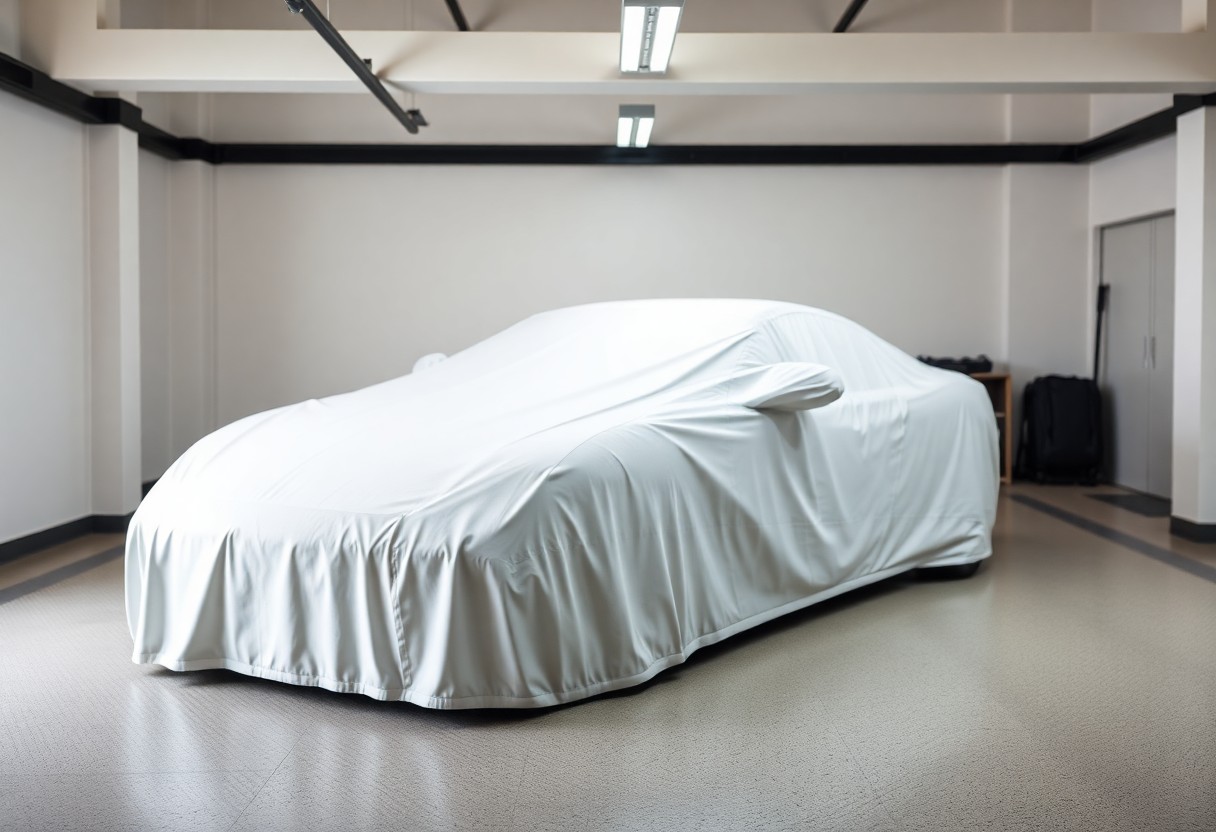
Covering a car outdoors in this climate is a more complicated call than it sounds. We have written about how covers trap heat in Las Vegas and what to look for if you use one. On a convertible the calculation changes again, because the cover is no longer resting on a hard painted panel. It is resting on fabric.
That matters in two ways. A cover that traps moisture holds it against a material that can grow mould. It does not simply bead off. A cover that moves in the wind also abrades a fabric weave far more readily than clearcoat. If a car has to sit outdoors then the top must be completely clean and completely dry before anything goes over it, and the cover has to be genuinely breathable. Indoors and out of the sun, the whole question stops mattering, which is the simplest reason to put a convertible under a roof rather than under a sheet.
Everything above is about the roof. A convertible going into storage needs the roof handled on top of everything any stored car needs, not instead of it.
| Before it goes in. | Why it matters on a convertible. |
|---|---|
| Clean and fully dry the top. | Anything left on fabric has months to work into it. Trapped damp is a mould problem rather than a stain. |
| Treat it with a product made for its material. | Vinyl and cloth want different chemistry. The wrong one can do more harm than nothing at all. |
| Clean the rear window correctly. | A plastic rear window scratches and hazes easily. The wrong cleaner attacks the bond at its edge. |
| Condition the door and header seals. | Seals sit compressed in one position for the whole storage period. Dry valley air hardens them. |
| Decide the top position deliberately. | Folded fabric takes a set and stresses the window bond. Make it a decision, not whatever it happened to be. |
| Then the usual storage preparation. | Fuel, battery tender, tyres and fluids. Exactly as for any stored car. |
The mechanical side of that last row is covered in full under long term car storage in Las Vegas. The interior deserves a thought too. A convertible cabin takes more direct sun than a fixed roof car ever does, covered in heat and leather interiors.
What a building does that preparation cannot is remove the two inputs driving all of this. No direct sun means no ultraviolet reaching the thread, the adhesive or the fabric. A steady 50 to 70°F means the daily expansion and contraction cycle largely stops. That is a different proposition from a well prepared car sitting in a hot garage. It is why the difference between climate control and temperature control matters before choosing where a convertible spends the summer.
Convertibles come to us from Summerlin, Henderson, The Ridges, Seven Hills, MacDonald Highlands, Southern Highlands and Lake Las Vegas.
Up is the safer default for most cars, because folded fabric takes a set along the crease and a folded glass rear window puts the bond line under sustained stress. Stored up, the top sits stretched over its frame as designed. Check what your top maker or owner handbook specifies first, since some cars have a stated requirement, and store it that way.
Usually the thread at the seams and the adhesive around the rear window, not the outer material. Both are thin polymer layers doing structural work, so ultraviolet takes strength out of them faster than it visibly damages the panels around them. That’s why a top can look acceptable and still open a seam or release a window corner.
It’s better than nothing and it carries its own risks. On fabric a cover can trap moisture against a material that grows mould, and wind movement abrades a weave much faster than it abrades paint. If you use one, the top must be clean and completely dry first and the cover genuinely breathable. Indoors out of the sun removes the problem instead of managing it.
A power top has seals and rams that sit in one position for the whole storage period, and there’s a reasonable argument for cycling it occasionally. There’s also a risk in operating a mechanism when nobody is watching the fabric. Tell us what you want done with your car and we’ll follow it rather than applying a blanket rule.
REVCity holds 50 to 70°F and 40 to 50% relative humidity in a fully enclosed building. Steady temperature matters more here than on a fixed roof car, because the daily expansion and contraction cycle is what works the bond between glass and fabric. No direct sun means no ultraviolet reaching the thread or the adhesive at all.
That depends on your policy and collector cover works differently from standard auto cover. Hagerty writes agreed value policies for collector vehicles and expects proper storage documentation rather than monthly start ups. Confirm the agreed value and the storage terms before the car goes in. Call 725-272-1803 for current availability.
Climate controlled storage for exotic, classic and collector vehicles at 50 to 70°F and 40 to 50% relative humidity, with BendPak lifts, quality battery tenders and 24/7 monitored access. 7185 Bermuda Rd, Las Vegas NV 89119.
REVCity Auto Storage · 7185 Bermuda Rd, Las Vegas NV 89119 · 725-272-1803